
Claude Ship reviews, fixes and approves pull requests: who keeps the final say?
Anthropic's Code Review, PR Steward and Claude Approvals take a PR from review to an approval decision under a policy the team writes, with a new /ship command.

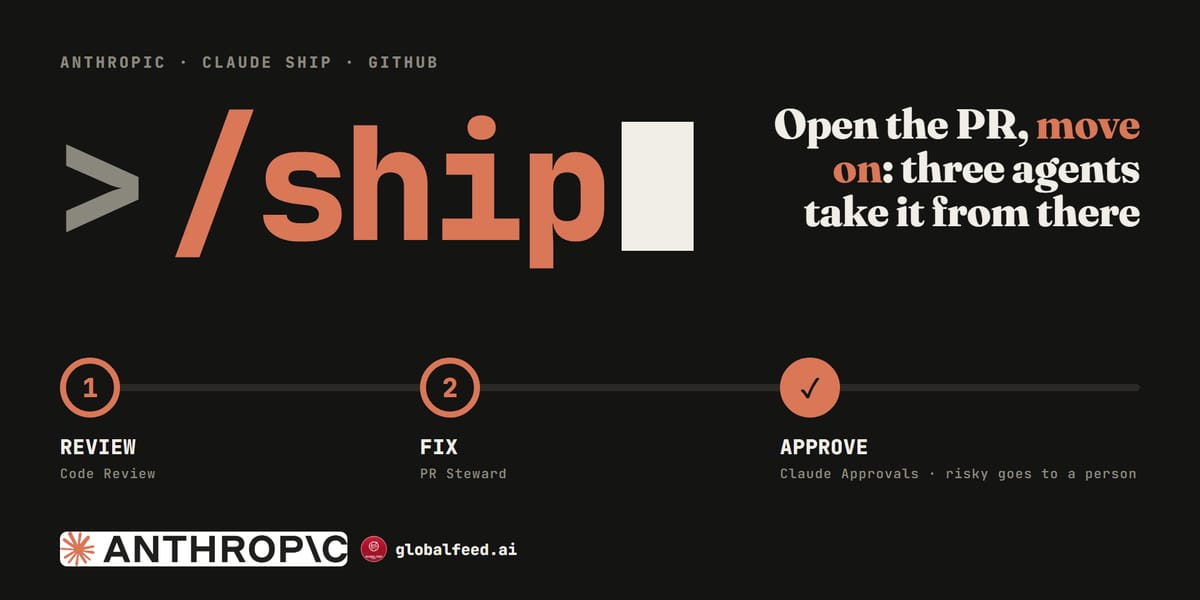
Anyone who writes code knows the loop: a change gets ready, a pull request (PR) goes up, and the developer moves on to the next task. Then the review comments arrive. The developer stops, digs back into the old code, pushes a fix, waits for the tests to run again and finally goes looking for someone to approve it. With Claude Ship, introduced on November 23, Anthropic proposes handing most of that loop to agents. Claude Ship reviews PRs, fixes them and approves the ones that fit a policy the team writes.
Anthropic's reasoning is simple: many developers now write a large share of their code with agents. The company says Claude writes most of the code on the Claude Code team. When code arrives that fast, the bottleneck moves to the steps after the PR: review, fixes and approval. This piece covers Claude Ship's three agents, how a PR moves through them and where control stays with the team.
Three agents, one path
Claude Ship has three parts. The first is Code Review, which already left preview. It reads a change together with the surrounding code and looks for logic errors, security vulnerabilities and missed edge cases. It collects findings from several angles, adversarially verifies each one, ranks them by severity and posts them as comments on the lines concerned. Teams pick a Quick, Standard or Deep review level for each repository.
The second part is a new agent, PR Steward. Its job is to keep a PR green: it takes on failing checks, merge conflicts and review comments, whether they come from Code Review, another review tool or a teammate. After every push it comments with what it changed and how to undo it. Developers can steer it by commenting "@claude" with an instruction, or step it back with "@claude stop". By design, PR Steward does not approve or merge pull requests.
The third part is Claude Approvals. The team puts an approval policy file, .claude/approvals.yml, in the repository. It sets how many people must approve changes to a given path and where Claude may post an approving review. Anthropic describes it as a smarter CODEOWNERS file. A policy can weigh Code Review findings or the team's own classifiers written in natural language. Claude can approve a routine change on its own, while a risky one goes to a person.
A PR's journey
Anthropic gives an example from its own team. A customer was confused because the Analytics API documentation implied an Admin key could pull Pro and Team usage. A product manager on the Claude Code team asked Claude Tag in Slack whether a fix was in flight, and Claude Tag opened a PR. Code Review found nothing blocking, a docs reviewer signed off, Claude Approvals passed, and the fix merged the same evening. The company's point is that team members who do not write code can now act on customer feedback directly.
For developers the shortest path is the new /ship command. When a change is ready they run /ship in Claude Code: Claude pushes it, opens the PR, reviews the change and works on feedback and failing checks to get it ready to merge. What can merge depends on the developer's permissions and the repository's branch rules. Admins can also turn Claude Ship on for a whole repository, and then the agents start on the team's PRs without anyone typing a command.
Anthropic also shares a number on Code Review's effect inside its own team: on the Claude Code team, where Claude's review is one layer of a broader process, merged PRs more than doubled from June to September while the share of reverted PRs fell by more than 40%.
Where control stays
The setup order is cautious. According to the docs, agents are turned on one at a time per repository: Code Review first, then PR Steward, then Claude Approvals. For PR Steward the suggested start is manual triggering (@claude steward). Claude Approvals should first run in observe-only mode, where the check reports what the policy would decide without blocking merges. Once the team trusts the results, it can configure branch protection to require Claude Approvals' green light.
Claude Ship works with existing branch protection and required checks. The docs flag one point in particular: with GitHub auto-merge or a merge queue and a policy that does not require a person's approval, a change can merge without anyone acting. Anthropic also states plainly that Claude Ship uses AI and may miss bugs, security vulnerabilities or other issues.
Who can use it and how it is billed
Claude Ship is available on Claude Team and Enterprise plans for repositories on GitHub. Code Review is generally available, while PR Steward and Claude Approvals are in beta. Usage is billed on tokens, separately from a plan's included usage. Cost depends on the number and size of PRs covered, the review level, how often reviews run and how much work PR Steward does. Admins can set spend limits for Code Review and PR Steward. Claude Approvals has no base charge, but classifiers in a policy and the Code Reviews a policy asks for are billed, even in observe mode. Running /ship counts as regular Claude Code usage.
Organizations with Zero Data Retention, the HIPAA configuration or customer-managed encryption keys cannot use Claude Ship for now. Eligible Enterprise organizations can claim at least $10,000 in Claude Ship credits by January 15, 2027, to be used within 30 days of claiming.
Claude Ship aims to carry the speed of agent-written code into the steps after the PR. The team writes the rules, chooses where the agents run and can watch everything in observe mode first. For a developer who wants to try it, the starting point is simple: update Claude Code and type /ship on the next change.
Sources: Anthropic announcement, Claude Ship docs

