
An audiobook narrator that clones your voice on a desktop CPU: how Tontaube V1.1 works
Berlin team Tontaube's 2.9B open voice model clones a voice from a short clip and reads long text like an audiobook. Here is what is inside, how it was trained and how to run it.

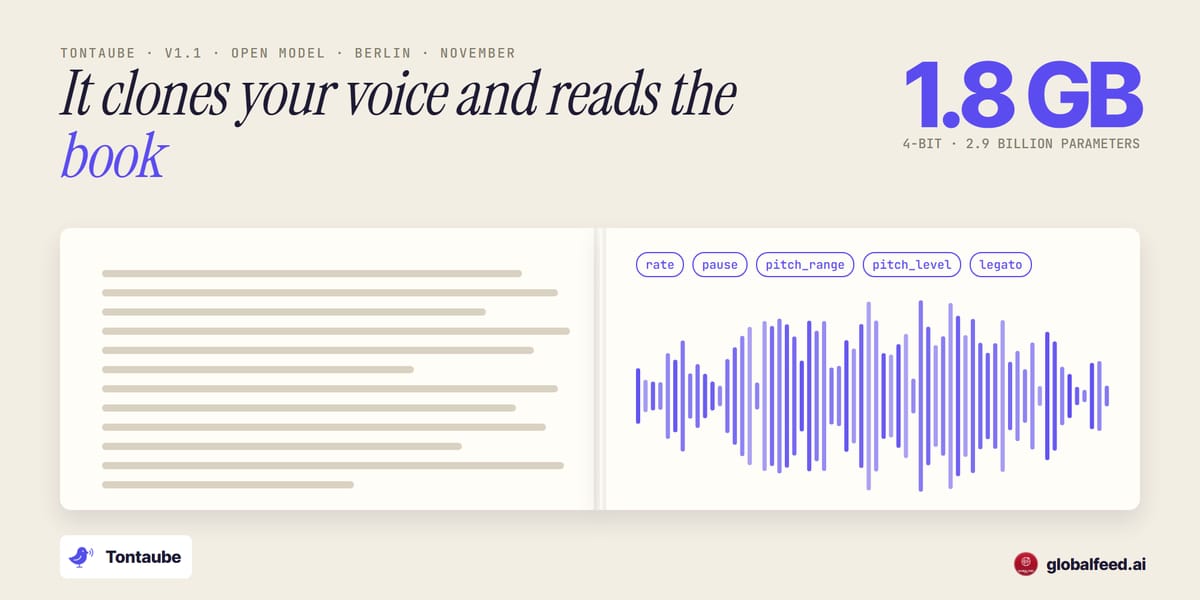
Picture an AI that reads a whole book aloud, in a voice you choose, on the processor of your desktop rather than in a data centre. Tontaube V1.1, released on Hugging Face this month by a two-brother team in Berlin, gets close. It has 2.9 billion parameters, the 4-bit version is a 1.8 GB download, it clones a voice from 5 to 60 seconds of audio, reads long text like an audiobook and takes five style controls.
What is new in V1.1
Per the model card, V1.1 adds sliders for speaking rate, pauses, intonation range, pitch level and crisp articulation, each set as an integer step, for example {"rate":1,"pause":3}. The bundle actually declares seven sliders; hesitation and varied pacing are trained in but not exposed. A VibeVoice adapter refines decoded audio, and a checker retries English pieces that skipped text. Languages are English, German, Spanish, French, Italian, Dutch and Portuguese.
Inside: four models
Audio becomes DualCodec tokens at 12.5 frames per second with four streams, so a minute of speech is 750 tokens. CB0, built on Qwen3-1.7B (1.85B parameters), generates the semantic stream and decides duration; CB1 to CB3, built on Qwen3-0.6B, refine the acoustic detail. The report says one model per codebook converged better. Long text is cut into 350-character chunks; CB0 sees the previous chunk and 50 characters ahead, while the acoustic stages carry no state, so voice drift cannot pile up. In a 3-minute test the final chunk's WER was 3.7% against 3.9% on short text.
How it was trained
According to the technical report, all four predictors were trained with supervised fine-tuning only, on about 200,000 hours of paired speech and text in seven languages, mostly public-domain audiobooks and open speech corpora; dataset names and schedules are not disclosed. The four finest DualCodec streams were dropped after listening tests showed little gain, a frequency penalty was added after repetition in early runs, and because DualCodec's decoder is not causal, streaming audio is re-decoded through VibeVoice's causal acoustic decoder. The int4 build uses GPTQ in groups of 64, keeping the audio head in int8.
Results, speed and how to try it
V1 scored 1.66% WER on Seed-TTS English (human recordings: 2.14%) and was preferred on prosody over Fish Audio S2 Pro in 281 of 400 listener comparisons; V1.1 has not been measured separately. The int4 model loads in about 4 GiB of VRAM, peaks near 6.5 GiB, reaches first audio in a median 192 ms on an RTX 5090 and runs about 13 times faster than real time per request, or 21 to 23 times batched. On a 12-core desktop CPU it runs at about real time. Clone the repo at v1.1.0, run uv run --python 3.12 --frozen tontaube serve on Linux and post text to /predict, adding voice_audio_b64 to clone. Windows works through WSL2, and there is a demo. Code is Apache 2.0; weights use the Tontaube Community Model License, free for research and for commercial use below EUR 200,000 group revenue, with impersonation without consent prohibited. We covered another CPU voice model, Kitten TTS 2 Mini, last week.
Sources: Hugging Face: TontaubeV1.1-int4, Hugging Face: TontaubeV1.1, Tontaube on GitHub, Technical report (arXiv), Licensing, Demo

