
An assistant that listens while it talks: how was InternLM's open Sage-Interaction built?
Shanghai AI Laboratory's open 9B full-duplex voice and video model; the MiniCPM-o 4.5 base, agent-generated training conversations and back-end task delegation.

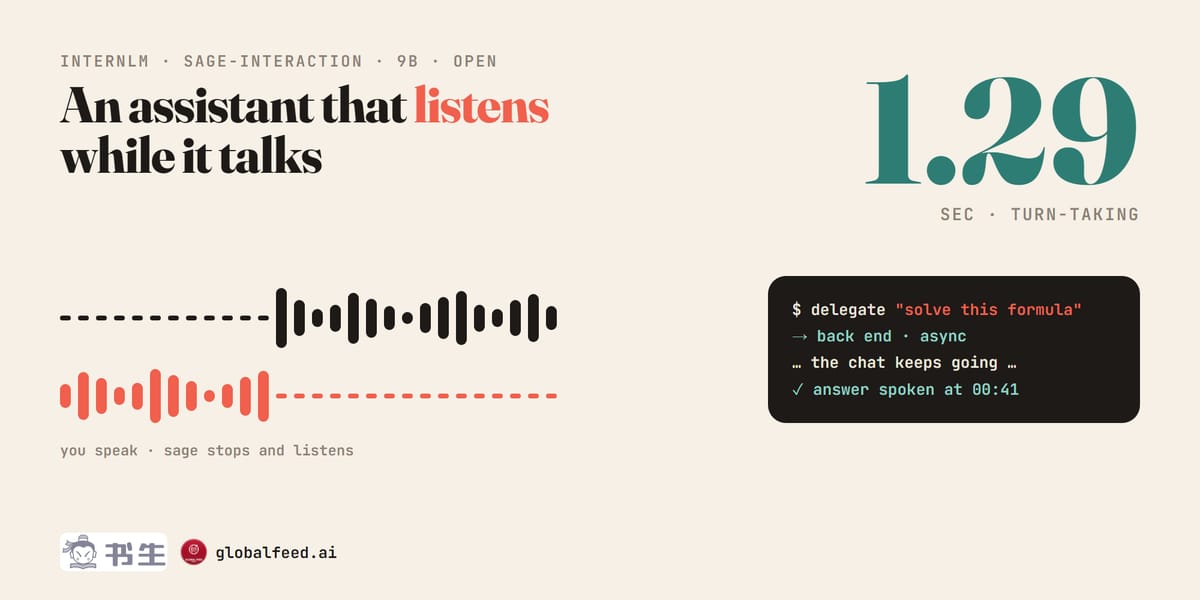
You open your camera and ask an assistant to solve a formula. It says "looking into it" and keeps chatting; while you ask about something else, it has already handed the job to a stronger model in the background, and when the answer arrives it speaks it at a natural point in the conversation. Interrupt it and it stops. Say "mm-hm" and it carries on. When someone talks in the background, it knows they are not talking to it. InternLM at the Shanghai AI Laboratory released Sage-Interaction, an open 9B model built for exactly this, on November 23.
It is a full-duplex voice and video assistant: it listens while it talks, processes live microphone and camera streams, speaks in real time and reacts to changes on screen. According to the project page, it scores 80.73 on the FD-Bench v1.5 average, ahead of all eight models it is compared with, and 80.47 F1 on a daily task-delegation test, also first. Code and model files are open under Apache 2.0, according to the GitHub README.
The problem: assistants that wait their turn
Most voice assistants work like a walkie-talkie: you talk, you stop, it talks. In that half-duplex setup it cannot hear you while speaking, you cannot cut in, and backchannels or background chatter throw it off. Human conversation overlaps. Full-duplex models keep listening while they speak and decide at every moment whether to stop or continue. The second problem is that a fast 9B model is quick enough for live speech but not for long reasoning, while a big model breaks the flow with latency. Sage-Interaction splits the two: a fast model in front, a stronger one thinking behind it.
How Sage-Interaction was built
The base: MiniCPM-o 4.5
Sage-Interaction is built on OpenBMB's open omni model MiniCPM-o 4.5, and its config uses the same model type. Per the MiniCPM-o 4.5 card, the system has four parts: a SigLip2 vision encoder, a Whisper-medium audio encoder, a Qwen3-8B language backbone and a CosyVoice2-based speech decoder. The config confirms it: a 36-layer backbone 4,096 wide with 40,960 positions, a 27-layer vision encoder with 64 query tokens per image, a 24-layer audio encoder with 80 mel bins and a 20-layer speech generator with a 6,562-token audio vocabulary. The 9.37B parameters take about 20 GB in BF16. Streaming runs in one-second chunks, and each chunk manages listening and speaking together.
Front end and back end: task delegation
The front end handles real-time interaction and visual context. When a request needs long reasoning or tools, the model recognises it as delegable, submits it asynchronously to the back end, keeps talking and folds the result into a later turn. Any OpenAI-compatible endpoint can serve as the back end, as long as it supports a model list, chat completions and structured JSON output.
Training data and objective
The team describes training in two sentences and has not published a technical report. Interaction trajectories were generated by a role-playing multi-agent system grounded in real-world scenarios: one agent plays the user, another the assistant, with interruptions, backchannels and background speech written into the scenes. The objective is an "asymmetric audio-video supervision" that treats the dense audio stream and the sparser meaningful video changes differently. Data sizes, stages and hardware are not disclosed.
What the tests show
On FD-Bench v1.5 Sage-Interaction averages 80.73, with Moss-Live next at 79.28. Turn-taking latency is 1.29 s, against 1.39 s for Doubao-Duplex and GPT-Realtime-2.1 and 2.13 s for Qwen3.5-Plus. It resumes after backchannels 96.94% of the time and after background speech 82% of the time. On delegation it reaches 80.47 F1 against 65.69 for GPT-2.1 xhigh and 63.35 for Qwen3.5-Plus, with answer quality of 4.13 out of 5 (Moss-Live leads at 4.36). On video, it scores 21.6 mIoU on Charades temporal grounding, against 0.9 for MiniCPM-o 4.5, and 42.3 on ProactiveQA.
The tables show weak spots too. Its FD-Bench v1 turn-over rate of 84.87 trails Qwen3.5-Plus at 100 and Doubao at 98.32; it resumes correctly when the user talks to someone else only 61% of the time (Moss-Live: 88.33%); and it scores 83.73 on Llama Questions against 91 for GPT-Realtime-2.1. The page does not give sample sizes or rival settings, so these are the team's own measurements. A language list is not published; the base model supports real-time speech in English and Chinese.
How to try it
Setup uses the scripts in the GitHub repo: Linux, a BF16-capable NVIDIA GPU, Python 3.12, CUDA 12.8 and flash-attn 2.8.3. Run scripts/prepare_environment.py, download the model to models/sage-interaction, put the back-end address in config.local.json, then start bash start_demo.sh --config config.local.json --gpu 0 and open http://127.0.0.1:18080/. The base model needs about 19 GB in BF16, with 28 GB recommended for its PyTorch demo. Delegation needs an OpenAI-compatible back end, which can be a local model server.
Sources: Sage-Interaction (Hugging Face), GitHub, Project page, MiniCPM-o 4.5

