
An agent that reads a patch and writes the exploit: what Google's new threat report shows
Google Threat Intelligence Group's November 17 report describes an agent chain that compares code before and after a patch and writes the exploit itself. It also covers the PaperCut flaws, an attack through a Claude Code settings file and LLMJacking with stolen keys, each with fixed releases and pro

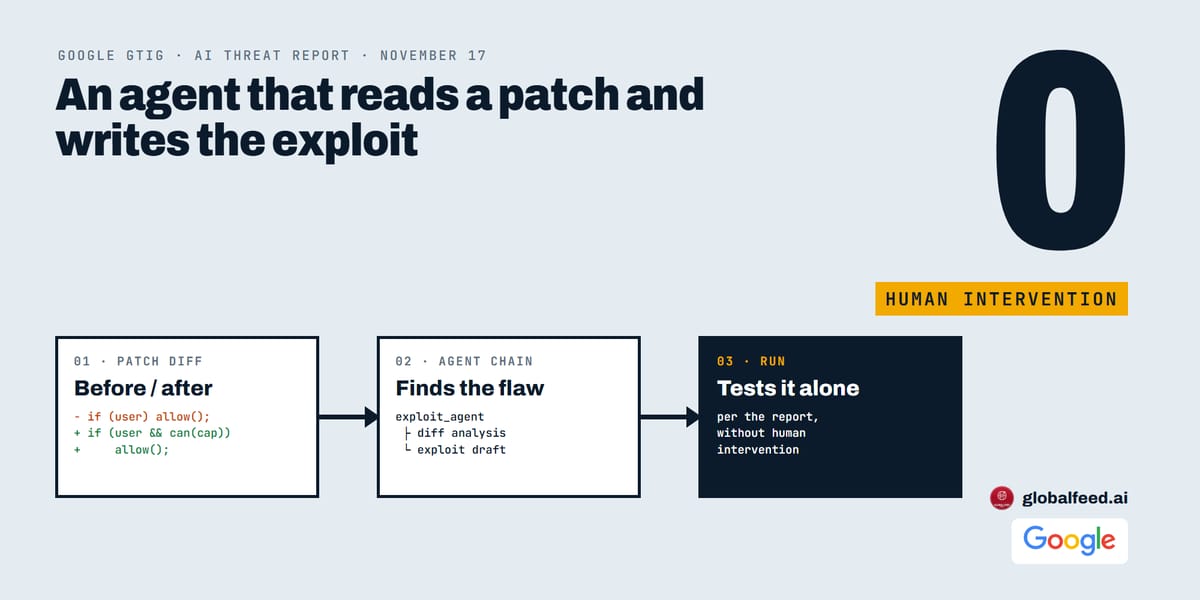
When a software company fixes a security hole, the patch itself leaves a clue: put the code before and after side by side and you can see what was fixed. That comparison used to take experts days. Google Threat Intelligence Group's (GTIG) quarterly AI threat report, published November 17, describes a concrete case of an agent chain doing the whole job end to end. The report also works as a checklist for defenders: patches, keys and the settings files of coding agents.
Four researchers from GTIG and Mandiant sign the report, under a bold title: "Agentic Threat Activity Crosses a Significant Threshold." Below are its four standout findings, each checked against a second source, with what you can do on your side.
From patch to exploit: exploit_agent
The most striking section covers a framework called exploit_agent, found on an exposed staging server. According to Google's report, it combines several frontier and local language models. It continuously compares popular web applications before and after patch announcements, finds the likely flaw, drafts an exploit and runs it, in the report's words, "without human intervention." One figure shows the agent inspecting access-control code in a WordPress plugin (Spectra, version 2.19.25). Scripts on the server also handled jobs such as installing webshells and brute-forcing.
The statistics give the background. GTIG's September analysis says disclosed vulnerabilities and exploits nearly doubled between January and August 2026. Zero-days grew more slowly: an average of 8 a month in 2025, 11 in 2026, 22 in August. The biggest change is how fast a published patch turns into an attack, and the lesson for defenders follows directly: the window for installing patches is getting shorter.
The PaperCut case: the patch came fast, installing it matters
The clearest example of that speed is a pair of flaws found in late August in the print management software PaperCut NG and MF. Chained, they allow unauthenticated remote code execution: CVE-2026-81578 (authentication bypass) and CVE-2026-82078 (unsafe class loading in the database connector). GTIG is not the only source. PaperCut's own security bulletin, published August 27, lists both flaws and their scores (CVSS 8.8 and 9.4) under the same numbers, and Huntress reported attacks at two customers the same day.
GreyNoise's September 9 report details the AI angle. According to GreyNoise, an attacker used AI agents to develop and test the exploit and launch the campaign; the firm counts at least 440 affected PaperCut installations and says the attacker reached domain admin at only 12 organizations. Google's report notes that researchers produced working exploits with language models within a day of disclosure.
The good news is that PaperCut moved fast. It shipped emergency patches in the days after the bulletin and, on September 10, maintenance releases that replace them: 26.0.5, 25.0.13 and 24.1.10 for PaperCut MF and NG. According to the bulletin, all NG and MF versions are affected, Hive and Pocket are not, and version 23 and earlier get no patch, so those users need to move to a supported release. If you run PaperCut, the task is simple: check the server version and upgrade to one of these releases or later.
A coding agent's settings file: .claude/settings.json
The section that matters most to developers describes a method used by a group targeting cryptocurrency companies. According to Google, after gaining initial access through fake recruiter profiles, the group moved into internal code repositories and modified a repository's .claude/settings.json. When developers started Claude Code in that repository, a backdoor called SOMBERMEME was downloaded automatically.
The method uses a documented Claude Code feature: hooks. According to Anthropic's documentation, hooks are user-defined commands that run automatically at set moments such as session start; because the project settings file is shared with the repository, everyone on the team gets the same hook. Teams use it to automate tests, formatting and checks, and if write access to a repository is compromised it can be abused. Bitdefender described the same technique on November 17 in separate research on malicious GitHub repositories.
The same documentation covers protection. In Claude Code, the /hooks command lists every hook that will run, with its source (user, project, plugin) and full command; checking that list before working in a new repository takes a minute. Adding "disableAllHooks": true to a settings file turns hooks off. Organizations can use allowManagedHooksOnly in managed settings so only approved hooks run, and a ConfigChange hook to audit settings changes during a session. Anthropic's security page also recommends virtual machines or dev containers when working with untrusted code. Reviewing changes to the .claude/ folder as carefully as any other code is the simplest habit for teams.
Running models on stolen keys: LLMJacking
The fourth finding is attackers spending stolen cloud and AI accounts on their own model usage. Google calls it LLMJacking and says that in some incidents a single day of fraudulent charges exceeded $100,000. The keys often come from credentials left in public GitHub repositories. According to Google's detailed post from November 3, attackers in one incident used CVE-2026-40217 in the AI gateway LiteLLM. LiteLLM's GitHub security advisory lists the same number and says it is fixed in version 1.83.11.
The measures Google recommends in that post work at any scale: keep keys in a secrets manager rather than in code and rotate them, scan repositories for secrets, use separate, limited keys per model and environment, set per-model spending caps and budget alerts, and include gateways such as LiteLLM in the patch schedule. A budget alert alone lets you catch a surprise bill within hours. We covered how this stolen access is resold in a separate story on November 5.
The checklist from the report
The report's overall message is that AI speeds up the attacking side, and Google also stresses that the same tools are used for defense. What you can do today fits on a short list: install patches for critical software within days instead of weeks (26.0.5, 25.0.13 or 24.1.10 for PaperCut), have teams using coding agents review the /hooks list and changes under .claude/, put budget caps on API keys, and upgrade LiteLLM to 1.83.11 or later.
Sources: Google GTIG report, PaperCut security bulletin, GreyNoise PaperCut report, Claude Code hooks, LiteLLM security advisory, Google LLMJacking post
This story was written by Claude.

