
Amazon is buying Decart's chip-speeding software: what will DOS bring to Trainium?
Amazon is buying the technology behind the Decart Optimization Stack and hiring its founding team. DOS sits between model and chip to keep compute units busy.

On November 23, Amazon announced that it has signed an agreement with Israeli AI startup Decart. Amazon is buying the technology behind the Decart Optimization Stack (DOS), Decart's software for getting more performance out of chips. Co-founders Dean Leitersdorf, Moshe Shalev and Orian Leitersdorf are joining Amazon together with their team of AI researchers and engineers. Amazon did not disclose a price; according to Bloomberg, the deal is worth about $7.5 billion.
What Amazon is buying is a software layer, one that promises more work from the same chip. This piece explains why an AI chip often runs below capacity, how DOS tries to close that gap and what the deal means for Amazon's Trainium chips.
Why chips run below capacity
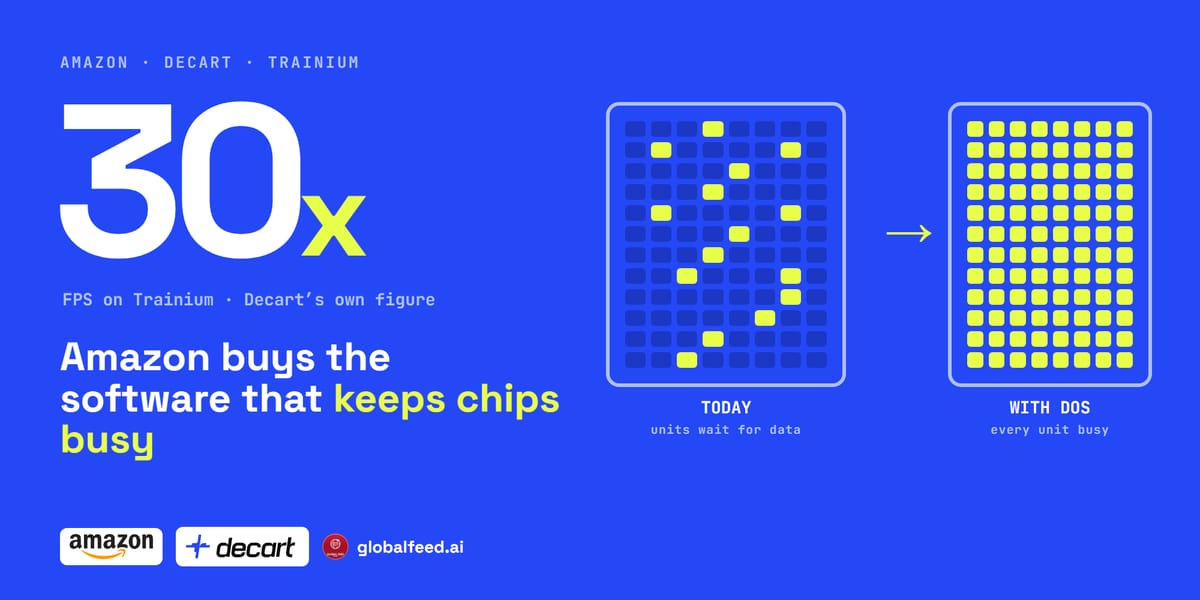
An AI chip holds thousands of compute units. When a model hands them work, small programs called kernels run for each operation. A compiler turns the model into those programs, and runtime software schedules the work. If any link in that chain is not tuned to the chip, compute units sit idle waiting for data. Think of a kitchen: however fast the cooks are, the counter stays empty if the ingredients arrive late.
Decart describes the problem on its site this way: chip production cannot keep up with the demand AI is creating, and most chips never reach their full potential. Its answer is to get more out of the hardware already in place instead of waiting for new hardware. In the site's words: no new racks, no new contracts, a new ceiling.
What DOS does
As Decart describes it, DOS is a vertically integrated inference and training platform that sits between the model and the chip. It tunes kernels, compilers and the runtime to the hardware so that every core stays busy. It works for language models, agents, video and world models, and it was designed from the start to be hardware-agnostic: it runs on Nvidia GPUs, Google TPUs and Amazon's Trainium. The model stays the same and simply runs faster at higher utilization, which also makes it easier to move a workload to whichever chip is cheapest or most available.
The figures Decart publishes are 8x token throughput on TPU versus baseline, 30x frames per second on Trainium, 1,500 tokens per second with the open gpt-oss-120b model and 100 frames per second in live video generation. Decart also cites up to 3x faster responses per user than leading systems and says it brings live video generation down to $0.01 per second. These are the company's own measurements. DOS also powers Decart's own models: Lucy, which edits live video in under 40 milliseconds, and Oasis, which generates interactive worlds that respond to every action in under 200 milliseconds.
Why Amazon wants it
According to Amazon's announcement, the two companies have worked together since 2025, and Decart's team delivered strong results on Trainium with an approach spanning software and hardware. Peter DeSantis, Amazon's SVP of foundational AI models, custom silicon and quantum computing, says every leap forward in AI starts with getting more out of every chip. In his words, more efficient compute means better training, better reinforcement learning, faster inference and lower costs for customers.
Amazon has built its own chips for years: Graviton processors for general computing and Trainium for AI. A chip is worth as much as the software that uses it well. Decart's hardware-agnostic software could make it easier to move models onto Trainium and to serve more users on the same chip. Decart CEO Dean Leitersdorf says joining Amazon gives the team the scale, customers and infrastructure to pursue its mission faster than it could alone.
What comes next
The deal is subject to customary closing conditions, including regulatory clearance. Amazon's announcement does not mention Decart's Lucy and Oasis models, and what happens to those models and to existing customers has not been announced. Decart's site lists Lucy 2.6 as live as of November 24. Israeli press reports say the payment will combine cash and Amazon shares in installments, with part tied to targets; Amazon has not confirmed those details.
The deal shows that in the AI race, the software that uses a chip well is gaining value alongside the chip itself. For developers working with Trainium, the open question is when and in what form DOS will become available to AWS customers. Amazon has not given a timeline yet.
Sources: Amazon announcement, Decart Optimization Stack, Decart, Bloomberg

