
Agnes 2.5 Pro Theta goes open: what a phrase memory does inside a 188B model
Singapore-based Agnes AI opened the 187.8B-parameter Agnes 2.5 Pro Theta under Apache 2.0. Here is how its 512-expert design, phrase memory and training are known to work.

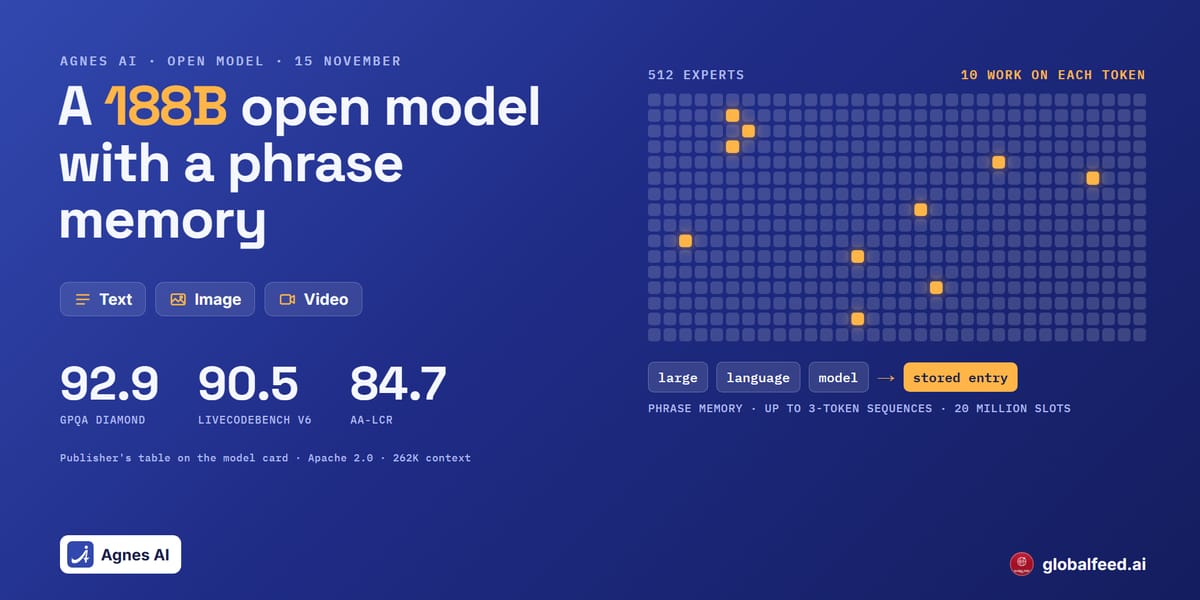
Many readers will be hearing the name Agnes AI for the first time. The lab, developed by Singapore Sapiens Technology in Singapore, says it trains its text, image, video and reasoning models in-house. On 15 November it published Agnes 2.5 Pro Theta on Hugging Face, a large open model with 187.8 billion parameters, text, image and video input, a configured context limit of 262,144 tokens and an Apache 2.0 license. The most interesting part sits inside the files. The model's configuration pairs a "phrase memory", a separate table that stores short, frequent token sequences, with a team of 512 experts.
Here is what the model does, what the scores on its model card say, how its architecture is built, what is known about its training and how to try it.
What it does
According to its model card, Agnes 2.5 Pro Theta is built for conversational reasoning, scientific problem solving, coding and visual understanding. Text, images and video frames go in through the supplied processors, and the model writes text. The card highlights English and Chinese. The chat template includes a thinking mode: the reasoning_effort and enable_thinking settings control how much the model reasons before it answers. The BF16 files come in 105 shards, together with the tokenizer, chat template and image and video processors.
What the scores say
According to the model card, Agnes 2.5 Pro Theta posts the highest value in the comparison table on five of the eight benchmarks the publisher selected. The table sets it against NVIDIA Nemotron 3.5 Super VL 120B, Qwen3.8-27B, GLM-5.3-Flash and DeepSeek-V4.1-Flash-1017:
- GPQA Diamond (graduate-level science questions): 92.9, against 92.8 for DeepSeek-V4.1-Flash-1017 and 92.2 for GLM-5.3-Flash.
- LiveCodeBench v6 (recent programming problems): 90.5, against 90.3 for Qwen3.8-27B and 89.7 for DeepSeek-V4.1-Flash-1017.
- AA-LCR (reasoning over long documents): 84.7; the closest is DeepSeek-V4.1-Flash-1017 at 80.4.
- IFBench (following complex instructions): 82.6, against 80.1 for Qwen3.8-27B.
- SWE-bench Pro (fixing bugs in real repositories): 64.1, against 61.7 for Qwen3.8-27B.
DeepSeek-V4.1-Flash-1017 leads the other three: 57.6 to 56.0 on SciCode, 25.3 to 16.8 on HLE-Diamond and 17.2 to 16.2 on GDP.pdf. The card notes that the AA-LCR result is labeled v1.1 and the SciCode result uses subproblem-level scoring. The publisher also states plainly that the scores come from its own chart and that prompts and raw run logs are not included. No separate image or video scores are given.
Architecture: four building blocks
The model card keeps the architecture brief, but the configuration file and model code that ship with it show the design clearly. Four pieces stand out.
A team of experts. Agnes 2.5 Pro Theta is a mixture-of-experts (MoE) model. Each block holds 512 small expert networks, and only 10 of them work on each token, alongside a shared expert branch that always runs. Think of a help desk with 512 specialists, where every question goes to the 10 best suited to it. Not all 187.8 billion parameters are computed at every step, so the model stays large while each step stays lighter.
Note-taking layers and selective attention. The 52 text layers follow a four-step pattern repeated 13 times: three "recurrent" layers, then one "indexed" layer. The recurrent layers summarize what has been read in a fixed-size state memory, updated in the code with a gated delta rule. Instead of looking back at every earlier word for each new one, the model reads a constantly updated notebook. The fourth layer uses classic attention, but a selector first picks the 2,048 most relevant earlier positions and attention goes only to those. It is like reading a long book by taking margin notes and flipping back only to the pages that matter. This pattern is how the 262K-token context is targeted.
A phrase memory. The configuration has a section called "lexicon". In the code this layer, LexicalLookup, hashes sequences of up to three tokens into a table with 20 million slots and joins the model at its second stage. The meaning of frequent short sequences is added from this table instead of being recomputed each time. The model card itself calls it a large lexical lookup table and warns that loading it can take extra memory. The idea is to shelve rote knowledge separately and leave the model's compute for reasoning.
Four parallel streams. Information moves between layers along four parallel streams, and a component called StreamMixer remixes them at every layer. It is one of the recent approaches for helping information travel through deep models without fading.
On the vision side there is a separate 27-stage encoder. It cuts images into 16-pixel patches, merges neighbors 2 by 2 and processes two video frames together. The resulting features are projected to the language model's width and join the same stream as the text. The vocabulary holds 248,576 tokens.
How it was trained
The model card does not disclose Theta's training data, its token count or its training stages, and no technical report has been published. What can be said about training is therefore limited, and everything here comes from the company's own documents.
Agnes AI says on its website that it trains its text, image, video and reasoning models in-house. Its previous large model, Agnes 2.5 Pro Alpha, released in July, stated openly on its model card that it was a post-trained derivative of Alibaba's Qwen3.5-397B-A17B. Theta's card names no base model. Its vocabulary size and vision encoder dimensions are very close to the Qwen3.5 family, while its layer count, width, phrase memory and four-stream design are different. In short, Theta is built on an architecture of its own, separate from Alpha.
The company's research page offers hints about its training approach. Its post-training report for Agnes Flash 2.5 proposes a six-stage recipe: building executable environments, collecting verified trajectories in them, supervised fine-tuning for agent behavior, training specialized experts, applying a reinforcement learning method called asymmetric PPO, and on-policy distillation from several teacher models. The company presents this as a training plan and describes its numbers as targets. It has also published a protocol for training a 2-billion-parameter model in two stages on clusters of 24 to 96 RTX 5090 GPUs, describing FP8 computation, a hybrid Muon and AdamW optimizer and late-stage checkpoint averaging. How far these methods were used for Theta has not been disclosed.
How to try it
The model runs locally with Transformers. The card says the setup was checked with PyTorch 2.14.1, Transformers 5.19.0, Accelerate 1.15.0 and Safetensors 0.8.0. Because it ships its own code, loading requires trust_remote_code=True, and the card recommends inspecting those Python files first. Default generation settings are temperature 1.0, top_p 0.95 and top_k 20, and the card includes ready examples for text generation and image understanding.
The card is clear about hardware: the unquantized files take about 349.7 GiB, a single copy needs at least 400 GB of disk, and the publisher points to 4 H200-class GPUs as a practical starting point. For those without that hardware, the model is also offered through the company's API. As of 15 November the list price in the API documentation is $0.10 per million input tokens and $0.30 per million output tokens, with cached input at a tenth of the input price.
License and the open model family
The Apache 2.0 license allows commercial use, modification and redistribution. Agnes AI's Hugging Face page also hosts earlier models such as Agnes 2.5 Pro Alpha, Agnes 2.5 Flash Base and Agnes 3.0 Flash. The list of large open models has grown quickly in recent weeks; earlier this month we explained how Moonshot trained Kimi K3.1 Pro.
For now the scores come from the publisher's own table, and independent measurements will show more clearly where the model stands. Shipping a phrase memory, selective attention and a team of experts in one openly licensed package already makes Theta worth a close look for anyone curious about model design.
Sources: Hugging Face: Agnes 2.5 Pro Theta model card, Model configuration (config.json), Agnes AI API documentation, Agnes AI research page, Agnes 2.5 Pro Alpha model card

