
A voice model that never heard a human: how the 18 MB tiny-voca was built for $9.56
The 4.5M-parameter tiny-voca was trained only on synthetic speech, runs on a CPU or in the browser and cost $9.56. Here is the recipe and what did not work.

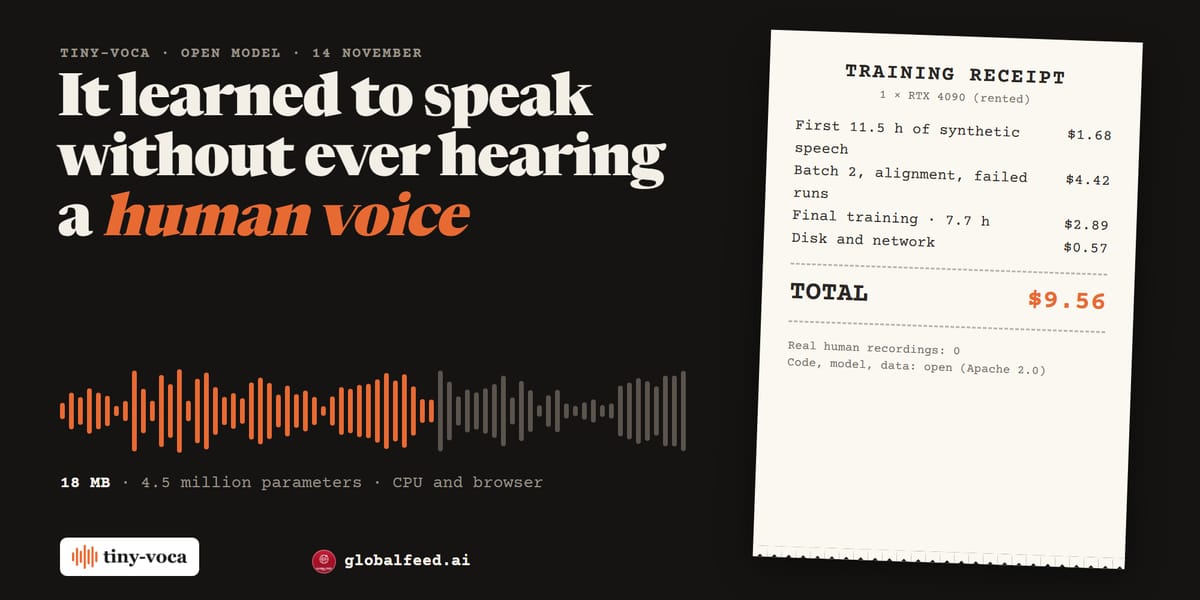
Training a text-to-speech model usually takes hundreds or thousands of hours of real human recordings. Developer Muhammed Nazeem tried another route: his model never heard a real human voice. tiny-voca, released on Hugging Face on 14 November, has 4.5 million parameters in an 18 MB file, was trained on 19 hours of synthetic speech from a larger model, and runs on a CPU or in the browser. Code, model, dataset and training recipe are all open, and the whole project cost $9.56 on one rented RTX 4090.
Learning from a teacher
Per the dataset card, two voices were designed from text descriptions with Qwen3-TTS VoiceDesign (F2, a bright woman in her mid twenties; M2, an upbeat light baritone in his late twenties), and Qwen3-TTS Base then read thousands of sentences in both voices: 17,371 clips, 19.1 hours. Text came from LibriTTS-R, Common Voice, LLM-written conversation and 600 templates for numbers, dates, money, names and questions. Whisper re-transcribed every clip; clips over 15% WER or with odd timing were regenerated once and dropped on a second failure.
Inside the model
According to the model notes, it follows FastSpeech 2: phonemes go through a 4-block encoder, a predictor sets durations and pauses, and two small transformers predict pitch, voicing and energy. There is no conventional vocoder. A pulse train at the predicted pitch and a noise signal pass through a time-varying filter, like vocal cords and the vocal tract, and the network only predicts that filter: 25,862 parameters. The author's own dizione phonemizer, written to replace GPL-licensed eSpeak NG, reads "RTX 4070 Ti" as "R T X forty seventy T I" and "-€12.50" as "minus twelve euros and fifty cents", at about 4,400 sentences per second on one core.
How it was trained
Training ran 104,737 steps in 7.7 hours on one RTX 4090: 66,000 steps on the first batch with eSpeak phonemes, then 38,737 on all data with dizione. The first 8,000 steps used spectral losses only, then GAN discriminators joined; recorded prosody was fed for 3,000 steps and faded out over 7,000. What failed is documented too: a learned aligner collapsed in all three attempts (97 to 99% of phones got one frame), so forced alignment with wav2vec2 was used; byte tokens were rejected; an eSpeak NG 1.51 bug dropped the last character of every input; and with fixed loss weights the GAN gradient was under 1% of the spectral one, so it is now scaled as a ratio. Final training cost $2.89 of the $9.56 total.
Results and how to try it
It runs about 70 times faster than real time on four CPU threads (the CPU is not named) and matched its teacher's Whisper WER on validation (0.6%) and test (0.9%); the author calls this a sanity check, and no listening test has been run. Try it in the browser at tiny-voca.n4ze3m.com, or clone the repo, pip install -e ".[own]", download the weights and run python -m tiny_voca.infer with --voice F2 or M2. It is English-only with two fixed voices. Code and weights are Apache 2.0, the dataset CC BY 4.0. For a larger multilingual CPU model, see our Kitten TTS 2 Mini story.
Sources: Hugging Face: tiny-voca, tiny-voca on GitHub, Model notes, Dataset, dizione phonemizer, Browser demo

