
A voice from a few seconds of speech: how does Reverb-TTS run this fast on a phone?
Software Mansion AI Labs' open Reverb-TTS clones a voice from a 3 to 20 second clip, speaks seven languages and runs at over 20 times real time on an iPhone 17. We explain masked diffusion, pruning with distillation, preference training and how to try it.

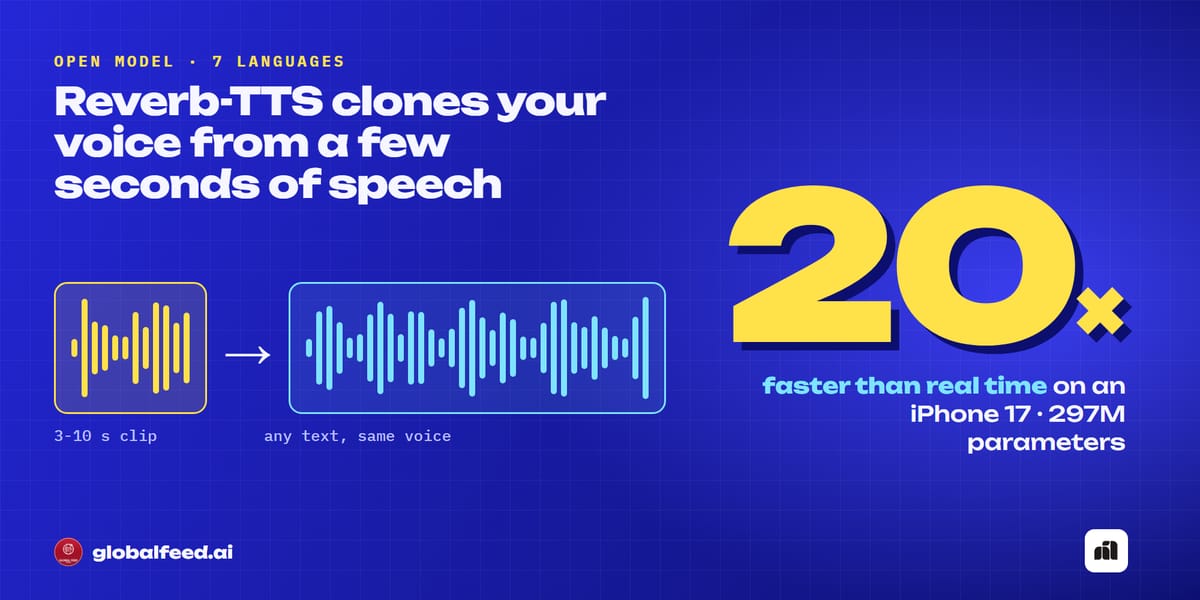
Record a few seconds of yourself reading one sentence, type the words you said, then paste in the talk you are giving tomorrow. A moment later you hear the talk in your own voice, and the recording never leaves your device. On 19 November Software Mansion AI Labs, the AI unit of the Polish software company behind several widely used React Native libraries, announced Reverb-TTS, a text-to-speech model built for exactly that. According to its model card, Reverb clones a voice from 3 to 20 seconds of clean speech with no fine-tuning and speaks seven languages: English, German, French, Spanish, Italian, Polish and Portuguese.
What makes it stand out is the balance between size and speed. Reverb has about 297 million parameters, less than half of the model it started from. Even so, Software Mansion measures it at 232 times real time on an NVIDIA H200 and above 20 times real time on an iPhone 17, so a ten-second sentence is ready on a phone in under half a second. The model also ships in formats that run directly on phones and in the browser.
How it works: filling a grid in a few passes
Most speech models produce audio the way you write a sentence, one piece after another. Reverb is a masked-diffusion model: it lays out a grid of audio codes for the whole utterance and fills it in over several passes. Each cell is a code from Boson AI's Higgs Audio v2 codec, which splits every second into 25 frames and every frame into 8 codebooks. The model commits to the cells it is most sure about first and fills in the rest later, much like solving the easy letters of a crossword before the hard squares.
With the default settings, 8 main passes decide the first two codebooks, which carry content and timing, and the model can withdraw earlier picks it has come to doubt. Polish passes then fill the remaining codebooks and pull the voice colour towards the reference. The usage guide reports 1.35% word error rate on the MiniMax test with this remasking on, against 1.50% with it off. The model needs two inputs: a short clip of the voice and its exact transcript. Tone, pace and emotion come from that clip; there is no separate emotion setting.
How was it trained?
Reverb starts from OmniVoice, an open masked-diffusion model of about 613M parameters from the k2-fsa team (our earlier story on OmniVoice). Software Mansion turned it into Reverb in three documented stages. First came pruning with distillation: 4 of the 28 transformer layers were removed, the feed-forward width cut from 3,072 to 2,048, the key-value groups from 8 to 6 and the text vocabulary from 151,676 to 62,035 tokens. The smaller model was then trained to match OmniVoice's predictions, recovering part of what the cuts removed.
Second, the model was retrained in its seven languages on cleaned and selected subsets of open speech data, including Emilia and cleaned versions of YODAS2 such as yodas2-sidon. The training text was in spoken form, with numbers, dates, money and abbreviations written out as words, so input text must be normalized the same way; the company released a separate open tool, Verbalis, for that. Third came preference post-training in the style of RLHF: the model generated several takes per prompt, a critic fitted on human preference rankings and a CTC intelligibility check picked the better and worse takes, and DPO trained on those pairs over several rounds. The result is 10 to 20 times faster than OmniVoice by the company's measurements.
The numbers
On the MiniMax test set of Hugging Face's Open TTS Leaderboard, 100 sentences in each of seven languages with every model cloning a reference recording, Reverb averages 1.03% word error rate, against 1.13% for OmniVoice, 1.20% for VoxCPM2 and 1.35% for Fish S2 Pro. With the leaderboard's default voice it scores 0.96%, the lowest listed. On speaker similarity OmniVoice stays slightly ahead, 0.833 against 0.817. At batch 32 on an RTX 5090, Reverb runs at 164.9 times real time against 13.2 for OmniVoice. The Nativ team measured its own Mac port: on an M5 Max, a 7.52-second English sentence took 126.5 ms in BF16, or 59.5 times real time, with peak memory of 3.24 GB.
How to try it
The quickest route is the demo Space, which runs Reverb on your own GPU in the browser through WebGPU; Chrome or Edge is enough. Upload your own clip or pick one of the 16 preset voices. In Python, pip install reverb-tts, then load with TTS.from_pretrained, build a voice with tts.voice and speak with tts.generate. A voice can speak any of the seven languages, so an English clip can read a Polish sentence. On a Mac, Neywa Labs' Nativ app runs it locally, and mobile developers can use react-native-executorch or ruNNtime. The smallest variant is 191 MB, and the company saw no quality loss from the 8-bit version. Keep the reference at 3 to 10 seconds of clean speech, record somewhere quiet, and clone only voices you have the right to use.
Reverb's code is Apache 2.0 and its model files are CC BY-NC 4.0, free for any non-commercial use with attribution. The code, the training method and the benchmarks are on GitHub.
Sources: Reverb-TTS model card, Reverb-TTS on GitHub, Reverb demo Space, Reverb on Nativ, OmniVoice

