
A translator that fits in your phone: how PLaMo 3 Translate was trained
Preferred Networks released PLaMo 3 Translate as open models in four sizes from 0.8B to 31B parameters, translating among 53 languages. We explain the translation tournament, the big model teaching the small ones and the methods that were dropped.

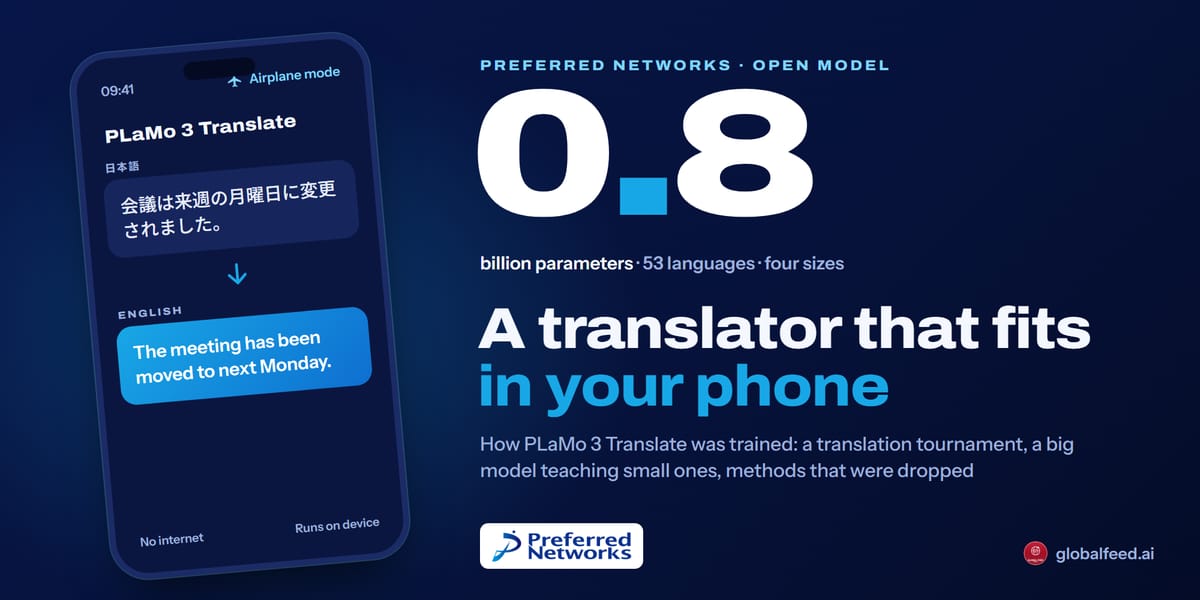
You switch your phone to airplane mode. No internet, no cloud, no connection to any server. You type a paragraph of Japanese and a clean English translation appears a few seconds later. Tokyo-based Preferred Networks (PFN) shared this scene as an internal demo. The model behind it is now in everyone's hands: on November 5 the company released the PLaMo 3 Translate family as open models on Hugging Face and explained step by step how it trained them in a long technical post.
The family comes in four sizes: 0.8 billion, 2 billion, 8 billion and 31 billion parameters. The models translate among 53 languages, with Japanese and English as the family's core specialty. Each size ships in seven file formats, with separate builds for server GPUs, laptops and Apple's own chips. The smallest model's compressed version is just 0.57 GB. PFN has been running the same model behind its paid translation service PLaMo翻訳 since early October.
A big claim for a small model
The post's most striking line is about the smallest model. According to PFN, the 0.8B model beats the translation models it was compared with on Japanese-English and on Japanese and other languages, including models 30 times its size. The comparison covers Google DeepMind's TranslateGemma and Tencent's Hy-MT2. Between English and other languages, the 2B model reaches the same result.
The large model was also matched against commercial services, with Gemini 3.1 Pro acting as judge and picking the better of two translations. According to the table in the Japanese product post, the 31B model won 87 percent of comparisons against DeepL and 86 percent against Google Translate on English-to-Japanese business text. From Japanese to English the figures are 58 and 71 percent. PFN states plainly that the only system that beats its 31B model on Japanese-to-English is Claude Fable 5.1, and by the company's calculation it does the same job at about one eighty-fifth of the cost.
Part of the cost gap comes from token efficiency. Language models read and write text in tokens; fewer tokens mean more speed and a smaller bill. In PFN's measurement, PLaMo 3 Translate writes 1,000 Japanese characters in 447 tokens. Claude Fable 5.1 uses 893 and GPT-6 Astra 744 for the same text. In English the figures are 205, 352 and 224.
How it was trained
PFN did not train a translation model from scratch. The starting point was PLaMo 3 NICT, a third-generation base model the company built with Japan's National Institute of Information and Communications Technology (NICT). That model had learned language from trillions of tokens but had no special skill at translation. The team taught it in four steps.
1. Filtering source text. The first job was finding good text to translate. The team ran web and other corpora through a series of filters: spam-heavy sites were dropped, the number of texts from any one site was capped, and texts were clustered so topics would vary. Text mixing several languages, stray Chinese characters in Japanese, and Malay slipping into Indonesian data were removed. Sites believed to be machine-translated were excluded entirely. The team's preference is clear: the model should learn from text written by native speakers.
2. Producing translations. Google's open model Gemma 4 31B produced the matching translations, using three techniques. The first is a kind of tournament: several candidate translations are generated, paired off, and in each match Gemma picks the winner while folding the loser's strengths into it. PFN says this beat generating many candidates and simply picking the best. The second is back-translation: the translation also served as input with the original text as the expected output, teaching the reverse direction. The third is self-improvement: later in training, the newest PLaMo generated fresh candidates, they went through the tournament, and better ones replaced the old translations.
3. Two-stage fine-tuning. The model first adapted to translation on about 33.9 billion tokens. The second stage used a smaller but far more varied set of about 3.4 billion tokens covering academic papers, literature, technical documents, finance and medicine, patents, news, idioms, casual speech, meeting transcripts and file translation. PFN compares the second stage to tens of thousands of paperbacks. The total is about 37.3 billion tokens.
4. Passing it down. The 8B and smaller models used the 31B model as a teacher. Think of a master who shows an apprentice not just the right answer but how likely each word looked. The student learns from ready-made translations and from its own attempts, which the teacher corrects. The method builds on two recent papers, DistiLLM-2 and AMiD, and PFN credits it to Kentaro Shinagawa, a summer 2026 intern. In the post's own words, the approach is "first building a large model, then using its capabilities to train smaller models."
The final touch was preference training. The model produced several translations of the same text, Gemma 4 ranked them as judge, and the model was updated to move toward the better one and away from the worse. This is called DPO. The team added two brakes to the loss so the model would not drift far from its previous state. The 31B model went through two rounds.
What was tried and dropped
The most useful part of the post covers what did not work. Early on, the team tried GRPO, the reinforcement learning method popularized by DeepSeek's reasoning models. Benchmark scores went up, but human evaluations showed the translations becoming less fluent, even when the judge was explicitly told to watch fluency. PFN attributes this to the model learning to please the judge instead of the real goal, and dropped the method.
The second lesson is about where effort pays off. In the previous PLaMo 2 Translate, DPO brought large gains. In PLaMo 3, most of the gain came in fine-tuning, that is, from data quality. DPO's contribution was small: in judged comparisons, the model after the first DPO round beat the fine-tuned-only version 57 to 59 percent of the time, and the second round beat the first 53 to 57 percent.
Architecture and files
According to the 31B model's configuration file, the model has 64 layers. Attention uses 8 key and value heads for 64 query heads, which keeps memory light. Some layers look only at the last 2,048 tokens while others see the whole text. The vocabulary has 107,520 tokens. During training, input and output together were capped at 32,768 tokens.
Besides full-precision BF16, the models ship in FP8, W4A16, W4AFP8, NVFP4, GGUF for llama.cpp and MLX for Apple chips. The full 31B model is 63.5 GB and the 4-bit GGUF is 19.5 GB. PFN's tables show the compressed versions keeping almost the same quality as the full one. The biggest loss shows up in the smallest model's most aggressive Q2_K version.
How to try it
The easiest way to run it on your own machine is the GGUF version. The commands from the model card:
hf download pfnet/plamo-3-translate-31b-GGUF plamo-3-translate-31b-Q4_K_M.gguf --local-dir plamo-3-translate-31b-GGUF
llama-server -m plamo-3-translate-31b-Q4_K_M.gguf -c 16384 --port 8000 \
  --alias plamo-3-translate --jinja --no-prefill-assistant

# or in one line with Ollama
ollama run hf.co/pfnet/plamo-3-translate-31b-GGUF:Q4_K_M
The model uses its own prompt format, PFML3, which the chat template builds for you. Naming the target language is enough; if you leave out the source language the model detects it. You can add earlier paragraphs as context, pass a glossary that says how terms should be translated, and choose a polite or plain style for Japanese output. vLLM is supported for server use.
The models are released under the PLaMo Community License. According to the license, personal, academic and non-commercial use is free. Companies with less than 1 billion yen in revenue in their latest fiscal year can use the models commercially for free after filling in a registration form; larger companies sign a separate agreement with PFN.
All shared results are PFN's own measurements, and most use another language model as judge. Tests by independent teams on their own text will show more clearly how the small models behave in real work on phones and laptops.
Sources: PFN technical post, PLaMo翻訳 product post (Japanese), Hugging Face model page, GGUF version, PLaMo Community License

