
A robot learned pipetting from one demo: how was Ai2's open RoboTracker trained?
Ai2's point trackers for robot manipulation; 15 million tracks from 300 virtual houses, the point-sampling experiments that failed, a short fine-tune and 17 of 20 on a real robot.

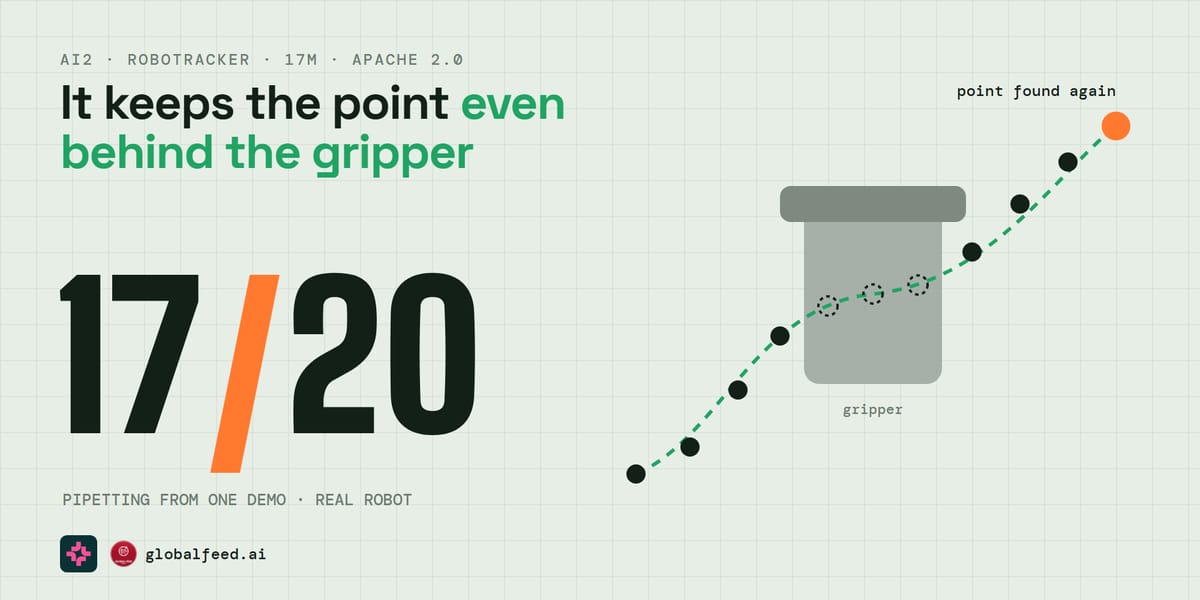
A robot arm grabs a knife and lifts it. In the camera view, the tip of the blade disappears behind the gripper for a moment and then comes back. For a human it is nothing; for most point trackers today it is the moment they lose the track. The Allen Institute for AI (Ai2) opened RoboTrack for exactly this on November 23: the 17M-parameter RoboTracker, the 1B-parameter RoboTracker-Warp, the 15-million-track RoboTrack-15M training set and the RoboTrack-Bench test set built from robot footage.
It was tested on a real robot too. The team taught a robot to move liquid between two vials with a pipette from a single demonstration, and using the tracker it finished the job in 17 of 20 layouts. A mask-centroid method managed 8 of 20 and classic optical flow 5 of 20. The 25-page report explains how the data was made, which experiments failed and how the models were trained.
The problem: point tracking meets the robot hand
Point tracking means following any point in a video frame by frame. Put a point on a mug handle; whether the mug turns, the camera moves or something passes in front, the model tries to say where that point is. For robots this is gold: demonstrations become point trajectories, and grasping, pushing and placing can be planned on them. The report argues manipulation is especially hard: grippers occlude objects, objects move and rotate with the robot, and hidden points must be found again. Existing robot benchmarks are mostly controlled tabletop scenes, and 48% of RoboTAP's points never move, so the team says those tests "overstate" how ready trackers are.
How RoboTracker was trained
Synthetic data: 300 houses, 1,500 episodes, 15 million tracks
RoboTrack-15M is fully simulated, with no human labels. The team took 300 ProcTHOR houses and recorded 5 pick episodes of a Franka arm in each, with scenes, objects and grasps from MolmoSpaces rendered in MuJoCo. Each episode has a wrist and an external camera: 3,000 videos with 5,000 tracks each, at 624x352, 15 fps and 70 frames on average, 17 GB in total. Every 20 frames, points are sampled from visible pixels of movable objects and robot links, lifted to 3D with depth, stored in the parent body's frame and reprojected; a point counts as visible if its depth matches the depth buffer within 3 cm. Mesh vertices were tried and dropped, because points near edges were ambiguous and low-poly objects left too few places to put them.
Two failures and the point-sampling lesson
The most instructive part is point sampling. Version one sampled the whole scene: 72% of external-camera points never moved, and fine-tuning on it gave no gain (61.5 AJ). Version two sampled only the robot and objects (62.8). Version three moved points on the fixed robot base onto the moving arm (63.0), and its motion statistics matched the real test videos far better. Fine-tuning on another synthetic set, PointOdyssey, dropped to 61.2 and hurt general video too, so the type of motion matters more than volume. More houses stopped helping: the robotics gain was 1.7 points at 10 houses, 1.8 at 100 and 300, and 1.6 at 1,000. Pseudo-labelling real video alone was not enough either: BootsTAPNext, trained on 15 million real videos, scores 60.2.
A short, targeted fine-tune
RoboTracker is a fine-tuned AllTracker. The team started from the Kubric stage-one checkpoint and replaced the 400K-step second stage with 10K steps at a learning rate of 1e-5, on a 50/50 mix of RoboTrack-15M and Kubric replay. It reaches 63.0, above the fully trained AllTracker at 62.6, in about 2 hours on 8 H200s. Most of the gain arrives with the first 25% of manipulation data, and the 50% mix gives the best all-benchmark average; training on manipulation data alone cuts the robotics gain to 1.0. RoboTracker-Warp applies the same recipe to the 1B CoWTracker, which uses feature warping on a pretrained VGGT backbone; its training code was not released, so the team re-implemented it, and training takes about 6 hours on 8 H200s. A control shows 1.2 of Warp's 2.1-point gain comes from RoboTrack-15M and 0.9 from extra Kubric training.
RoboTrack-Bench and results
The benchmark has 307 clips and 2,522 human-verified tracks from DROID, MolmoAct2, EgoVerse and Ego-Exo4D, covering four robot embodiments and human hands. Clips average 223 frames and 57% of points are occluded at least once. RoboTracker-Warp scores 66.0 AJ, against 63.9 for CoWTracker and 61.8 for CoTracker3; the small RoboTracker scores 63.4, above AllTracker's 62.6. Warp beats CoWTracker on every source, including human hands, although training used only a Franka arm; on DAVIS it trails slightly, 65.93 to 66.14. Long occlusions, reappearance and small objects that blend into the background remain hard, and Warp runs at about 18 fps, too slow for closed-loop control. RoboTracker is Apache 2.0; Warp is CC-BY-NC 4.0 for research use.
How to try it
Code is on GitHub: install PyTorch, run pip install -e ., then evaluate with python -m robotrack.eval_alltracker --checkpoint robotracker. RoboTracker is a drop-in replacement for the AllTracker checkpoint and runs on an ordinary GPU; RoboTracker-Warp needs the CoWTracker repo and about 47 GB of GPU memory. Generation scripts for RoboTrack-15M are included. The team advises validating tracks, bounding commanded motion and keeping an emergency stop on real robots.
Sources: Ai2 blog, Technical report, GitHub, RoboTracker, RoboTrack-15M

