
A million records in 54 ms: how was Tencent's OmniEVIE-4B trained?
Tencent's open OmniEVIE-4B searches text, images, documents and video in one space; 22 million public samples, four training stages, specialist merging and 128-vector compression.

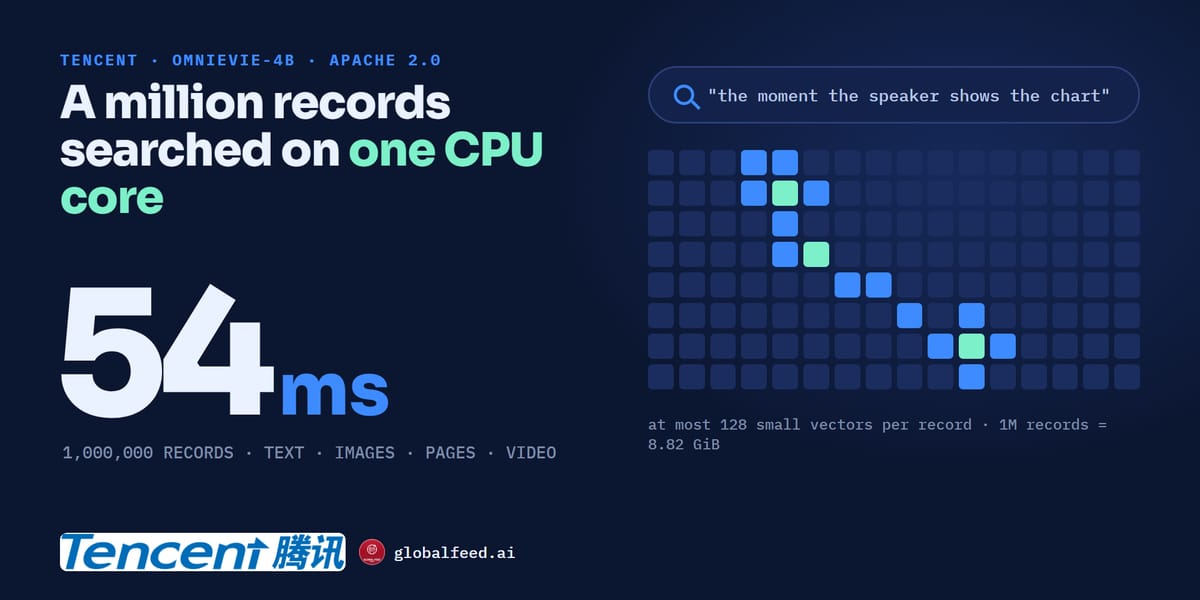
Picture an archive of a million records: scanned contracts, product photos, meeting recordings, slide decks. You search for "the slide with last year's price table" or "the moment the speaker shows the chart", and the answer arrives in 54 milliseconds on a single CPU core. It does more than find the file: it points to the region of the page or the second of the video. OmniEVIE-4B, which Tencent opened under Apache 2.0 on November 24, is a 4.5B-parameter retrieval model built for exactly that.
It represents text, images, document pages and video in one space and also covers agent tasks such as tool and interface retrieval. According to the 28-page paper from Tencent's IMA Product Center and Youtu Lab, OmniEVIE-4B leads the 190-task MMEB-V3 leaderboard (audio excluded) with 60.06. What makes the paper worth reading is how openly it walks through the training, the experiments that failed and how a million records fit in under 9 GB.
The problem: one vector loses the detail
Retrieval models turn a document into a numeric fingerprint, an embedding. The query is turned into one too, and the nearest fingerprints come back. The classic approach squeezes each document into a single vector. That is fast, but a small table in the corner of a 40-page report or a three-second scene in the middle of a video gets lost. The paper names three problems: single vectors lose local detail, cross-encoders that reread every candidate are too slow, and late interaction, which keeps a vector for every token, grows too large to serve.
Think of a library. A single vector is the one-paragraph blurb on the back cover. Late interaction gives every paragraph its own index card, so the card holding your sentence rises to the top. The price is a giant card cabinet: storing every token of a million records at 2,048 dimensions takes about 3,824 GiB by the paper's count. OmniEVIE keeps at most 128 small vectors per record and fits a million records into 8.82 GiB.
How OmniEVIE-4B was trained
Backbone: Qwen3.5 with bidirectional attention
The base is Alibaba's open Qwen3.5-4B. The config shows 32 language layers with a hidden width of 2,560 and a 24-layer vision encoder. The language layers alternate fast linear attention (GatedDeltaNet) with full attention every fourth layer, and the team made the full-attention layers bidirectional, so each token sees what comes before and after it. A single shared matrix at the output produces embeddings at six widths from 64 to 2,048 (Prefix-MRL), so the same checkpoint runs in full mode for top accuracy or in a compressed 64-dimension mode.
The video design is one of the most instructive parts. Instead of encoding frames one by one, the team packs them into one sequence and prefixes each temporal group with a timestamp in seconds. Encode frames independently and a clip played forwards looks identical to the same clip reversed. The ablation confirms it: with independent frames the video average drops from 78.74 to 71.13 and forward-versus-reversed accuracy falls from 75.63% to 51.17%, a coin flip.
Data: 22 million samples from 57 public datasets
Training used public data only, about 22 million samples from 57 datasets: 25.8% image retrieval, 24.9% QA and grounding, 15.6% text retrieval, 13.5% classification, 13% video retrieval, 5.2% tool retrieval and 2% document pages. Every sample has an instruction, a query, a positive, hard negatives and a teacher score, and every batch holds a single task.
A notable step is re-checking the negatives. Many results labelled wrong in retrieval datasets actually answer the query in part or in full, and training on them as negatives confuses the model. The team had a multimodal judge grade each mined negative three ways: full evidence becomes an extra positive, partial evidence is masked out of the loss, no evidence stays a hard negative. In the document pool, 175,137 of 775,635 queries gained an extra positive and 14.4% of candidate negatives were masked. For video, reversed clips and off-window clips from the same long video were added as negatives.
Four stages and several teachers
Stage one trains on documents only, distilling rankings from an 8B teacher, EVIE-8B. Stage two adds images and video, replaying earlier data at a fixed rate so the model does not forget. Stage three covers everything else: classification, QA, long text, tools, interfaces and memory, with three teachers chosen by answer type and a five-class sampling rule that switches distillation off when the base model is right and the teacher is wrong. The recipe is spelled out: AdamW, LoRA finetuning at rank 64 or 128, a learning rate of 2e-5, a global batch of 512 and one epoch per stage. MMEB-V3 climbs from 44.38 after stage two to 58.14 after stage three and 60.06 at the end. GPU counts and hours are not stated.
Stage four is a merge. Four specialists (video, fine-grained entities, visual QA, tool use) are added back block by block with separate coefficients. Linear averaging lifted MMEB-V3 from 58.37 to 58.80 and adding specialists from 59.44 to 59.67, while the paper notes that the specialists cost 0.32 points on document pages.
The compression ablations are just as candid. At 128 vectors of 64 dimensions on ViDoRe V3, a uniform grid pool scores 56.50, random token retention 60.41, the team's spatio-temporal clustering ST-HAC 62.96 and the uncompressed sequence 63.09. Dropping the fixed int8 scale falls to 57.82, and spending the same bytes on fewer, wider vectors loses (32 x 128 scores 61.82 against 62.47 for 64 x 64). Many small vectors keep detail better than a few large ones.
Why search is so fast
Each record takes 9,472 bytes. Search narrows in three steps: 256-byte mean vectors pick 5,000 candidates from a million, sign bits cut that to 1,000, and full multi-vector matching ranks the final ten. On one CPU thread a million records take 54.2 ms in total against 12,781 ms for exhaustive matching, and five million take 120.2 ms. Top-10 retention is 99.5% on documents and 98.2% on video. On 1,083 QVHighlights queries, the strongest match lands inside the labelled moment 78% of the time and the returned span overlaps it 94.3% of the time.
Numbers and limits
On MMEB-V3, 60.06 beats Tencent's own 9B WeMM-Emb (59.33) and Qwen3-VL-Embedding-8B (53.5), with a wider gap on agent tasks (54.03 vs 50.10 and 38.4). In full mode it scores 64.34 on ViDoRe V3, ahead of NVIDIA's 8B Nemotron-ColEmbed-V2 at 63.76. On the older 78-task MMEB-V2, WeMM-9B leads 80.58 to 77.96. The authors list reasoning retrieval, GUI and memory as the weakest areas, and audio is not supported yet.
How to try it
Code and model are on GitHub: pip install git+https://github.com/Tencent/OmniEVIE.git. It needs a CUDA GPU with FlashAttention 2; the team verified torch 2.7.1, transformers 5.13 to 5.17 and flash-attn 2.8.1. The BF16 model is about 9 GB, and Sentence-Transformers 6.3+ supports it through MultiVectorEncoder("tencent/OmniEVIE-4B"). Index search runs on a CPU, so once an archive is encoded, querying it needs no GPU.
Sources: OmniEVIE-4B (Hugging Face), Paper (arXiv), GitHub

