
A chat model that folds proteins by itself: how does Calpha do it?
The open Calpha project teaches Qwen3.5-9B to fold proteins mid-chat with no tool call. We walk through its two-stage training, the experiments that failed and the results.

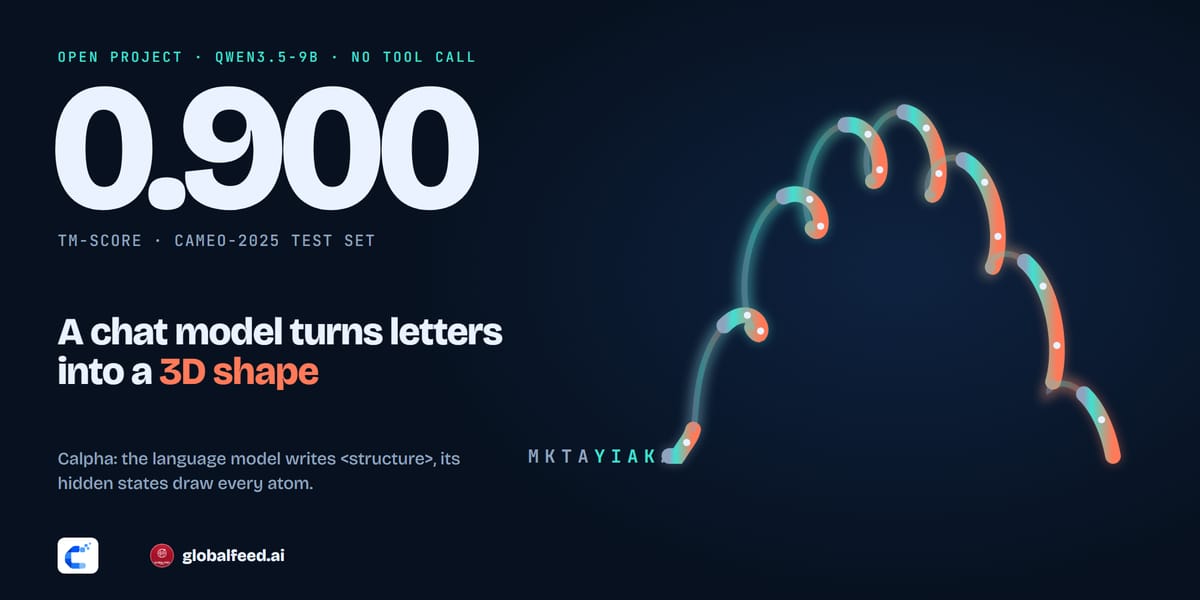
Imagine pasting a protein sequence into a chat model and asking "what does this look like in 3D?" Until now there were two ways this could go: the model either called a separate folding program as a tool and read back the result, or it answered in text only. The Calpha technical report, published on 16 November by a team led from Shanghai Jiao Tong University, tries a third way: a general-purpose language model decides mid-conversation to fold, and produces the atom coordinates itself. No tool call, no separate program; the decision and the structure come out of the same forward pass.
The project is open: the code is on GitHub, and the trained model files, benchmark outputs and 77 GB of training data are on Hugging Face. What stands out most is how candid the report is. The team lists what worked, what did not, and which experiments led nowhere.
The problem: protein folding
A protein is a long chain built from 20 kinds of amino acids. In the cell that chain does not stay straight; like earphone cables tangling in a pocket, it twists and folds into a specific three-dimensional shape, and that shape largely decides what the protein does. Predicting the shape from the letter sequence was one of biology's hardest problems for decades. Specialist models such as AlphaFold, ESMFold and SimpleFold now do it very well.
Those specialist models share one trait: a sequence goes in, a structure comes out. You cannot ask them a question, tell them what you read in a paper or ask them to explain their answer. Chat models such as ChatGPT, Claude and Gemini talk and reason but cannot produce structures on their own. The report measures this directly: asked to write alpha-carbon coordinates without tools, four frontier chat models (GPT, Claude Opus 5.5, Gemini and DeepSeek) scored mean TM-scores between 0.147 and 0.224, against 0.138 to 0.149 for a meaningless random-walk chain on the same targets. TM-score runs from 0 to 1, and above 0.5 means the overall fold is right.
Calpha's long-term goal is to bring both worlds into one model: one that folds proteins, predicts complexes, understands and discusses structure, and lets its language reasoning shape the structure it predicts. This report is the first step: getting the structure of a single protein chain out of a language model.
How it works
At the center sits Alibaba's open model Qwen3.5-9B. Its vocabulary is extended with amino-acid letters and a special <structure> token. The protein is written as letters inside an ordinary chat message, and each letter is enriched with what ESM2-3B, a model trained on proteins, knows about that residue. In the team's words, the language model sees each residue as "its letter plus what ESM2 knows about it".
If the question needs a text answer, the model keeps writing. If the user wants a structure, the model emits <structure>. At that point the hidden states from nine of its 32 layers are read, passed through a small 8.4M-parameter front-end and handed to Apple's SimpleFold-3B structure head, which uses flow matching to go from random noise to all-atom coordinates in 200 steps. The key detail: the head receives every piece of information about the protein only through the language model's states.
How it was trained
Training ran in two stages. In stage one, all parameters of Qwen3.5-9B, the ESM2 adapter and a small 100M-parameter SimpleFold head were trained together for 2 billion tokens. The loss has three parts: ordinary language loss, the loss for emitting <structure> at the right moment, and the head's flow-matching loss. On the language side, 75% of the data is protein tasks (designing a sequence for a given structure, secondary structure, contact prediction, infilling) and 25% general text and reasoning, all in English. On the structure side, 84,658 chains from the Protein Data Bank (PDB) were used, cropped to 256 residues. The model at the end of this stage is a working folding model in its own right, reported as Calpha-Joint.
In stage two the language model is frozen. The small head is swapped for the 2.86B-parameter SimpleFold-3B, which also stays frozen. The only trained part is the 8.4M-parameter front-end: 20,000 steps on 256-residue crops, then 10,000 more at 512. This stage took about 11 hours on eight H200 GPUs.
The most instructive part of the report is its development log. The team ranks the configurations it tried through October by score:
- Having the language model write the structure as ESM3 tokens: 0.562. Attaching a 100M flow head to the same model's hidden states raised it to 0.712.
- Hidden states from a plain Qwen with no protein training: 0.347. The language model first has to learn to read proteins.
- Training the structure head from scratch with random initialization: only 0.270. The structural knowledge in the pretrained head cannot be relearned on this budget.
- Unfreezing the 3B head did not help: from 0.801 to 0.792 at best, and 0.771 after 20,000 steps.
- Doubling training steps, doubling front-end capacity and letting the language model update each changed the score by less than 0.003. Continuing on 512-residue crops added 0.006, mostly on long chains.
- An early version trained on mixed Chinese-English language data triggered folding on only 5% of plain English requests. Switching to English only and dropping structure-token tasks fixed it within the first quarter of training.
What the results say
With a fixed folding request, Calpha scores mean TM-scores of 0.808, 0.635 (CASP16 domains) and 0.900 on the three test sets. A control system in which the same head reads ESM2 features directly, with no language model, scores 0.822, 0.682 and 0.917. For chains of 100 to 299 residues there is no measurable difference between the two. For 300 to 600 residues the language model costs accuracy on all three sets, most on CASP16 at 0.160. ESMFold is ahead of Calpha on two sets. The team says it plainly: routing through the language model does not yet make folding more accurate, and the gain the project is aiming for has not been measured yet.
On the language side, four of five tested folding requests triggered the structure on every example; the fifth did so 95.5% to 98.2% of the time. False triggers on protein questions that did not ask for a structure stayed between 0 and 1.4%. There is a cost: after protein training, accuracy on a 350-question MMLU-Pro subset fell from 77.4% to 70.3%. Cutting the general-data share from 25% to 15% cost five more points without improving folding.
How to try it
Running Calpha needs a single GPU with about 48 GB of memory, Linux and Python 3.12. After cloning and installing the repository, calpha fold folds a sequence, and calpha chat lets you ask in your own words while the model decides whether to fold. The code and trained parts are open under Apache 2.0; the SimpleFold-3B files that the code downloads to produce structures come under Apple's research-use license. The team does not recommend the model for clinical or diagnostic use.
AI work on proteins is multiplying fast. A few weeks ago we wrote about a Tencent agent that trained its own protein model from scratch. Calpha opens a different door: making folding a native skill of the language model instead of handing it to a tool. Next on the team's roadmap are complex prediction, reading structure as input and, most importantly, measuring whether an instruction or a line of reasoning can change the predicted shape.
This story is based on the Calpha technical report, GitHub repository and Hugging Face model card; the scores are the team's own measurements.
Sources: arXiv: Calpha technical report, GitHub: yliust/Calpha, Hugging Face: Calpha

