
153 pages, 380 checkpoints: what the K2-Horizon training notebook reveals
IFM at MBZUAI published the full technical report for its six open models. We walk through the data-mix study, the five merged experts and what went wrong along the way.

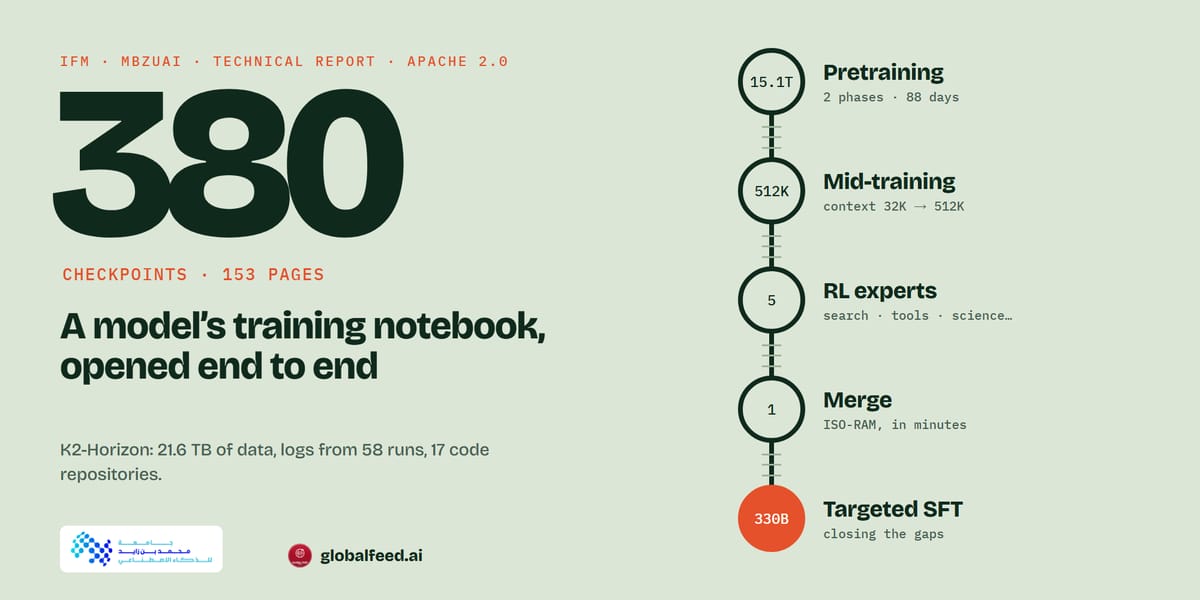
Training an AI model is like keeping a lab notebook for months: which data went in, where the run stumbled, which idea failed and which fix worked. For most large models that notebook stays closed. On 16 November the Institute of Foundation Models (IFM) at MBZUAI published exactly that notebook: the K2-Horizon technical report runs to 153 pages and walks through every stage of six models, with numbers.
We covered the K2-Horizon fleet when it launched on 4 September: six Apache 2.0 models from 0.9B to 375B parameters. The report now opens the kitchen and ships a large archive with it: 380 intermediate checkpoints, 23 quantized builds, 21.6 TB of training data, logs from 58 training runs and 17 code repositories.
Why 380 checkpoints matter
A checkpoint is a save point in training. Most labs keep them private and release only the final model. IFM put 380 of them on Hugging Face as separate branches; adding --revision pretrain_ph1_211000 to a vLLM command loads the flagship as it was at the end of pretraining phase 1. Researchers can watch when a skill appears, and teams can fine-tune from an earlier point. Four models (3.7B, 7B, 32B and 36B-A4B) were trained on the same 22T-token corpus with the same recipe, which makes clean comparisons of scale possible.
How it was trained
The 375B-A23B flagship is a 61-layer mixture-of-experts model with 192 experts per layer, 8 routed per token plus a shared expert, so about 23.6B parameters run per step. The 36B-A4B introduces Mixture-of-Value Attention (MoVA), which routes attention value projections to 4 of 64 value experts; it nearly matches the dense 32B trained on the same data with about one seventh of the active parameters. About 10T pretraining tokens are synthetic, and every pipeline that produced them is released. 88,625 documents were removed to avoid benchmark contamination.
The data-mix study is a highlight. At 1.5B scale an SFT-heavy mix led and a web-heavy mix came last. A two-stage method that predicts large-model scores from small runs reversed the order, ranking web-heavy first on 11 of 13 benchmarks at 31B. The team followed the prediction. The flagship saw 15.1T tokens over about 88 days of pretraining, then about 1.9T tokens of mid-training extending context from 32K to 512K, with agent trajectories added early. Post-training trained five RL experts (search, knowledge work, tool use, scientific reasoning, instruction following with abstention), merged them in minutes with ISO-RAM and closed remaining gaps with 330B tokens of targeted SFT.
What went wrong, and the fixes
Loss spikes recurred; the team rolled back 40 times, and 69% of phase-1 spike episodes sat on branches later discarded. The gradient norm only signalled in the last ten steps before a spike. Applying the math RL recipe directly to the 0.9B caused entropy collapse, solved by alternating math and code RL. Small models fell into repetition loops, fixed with a short preference stage built from their own looping outputs. A Markdown tool format saved 18.5% of tokens but required what amounted to a small compiler, and fixing a dob versus date_of_birth bug lifted BFCL from 74.65% to 76.98%. An audit found 24 of 500 Terminal-Bench 2.1 passes (4.8%) used shortcuts; counting them as failures lowers 70.2% to 66.9%, and the report gives both numbers.
Results and how to try it
Among the open models compared, 375B-A23B leads Toolathlon-Verified (65.3) and SWE-Atlas-QnA (48.4) and is second on Terminal-Bench 2.1 (70.2). Claude Sonnet 5 (71.6) and GPT-5.6 Luna (67.5) score higher on Toolathlon, GPT-5.6 Terra (64.8) lower. Expert science remains the gap (HLE 32.0, CritPt 8.6). The flagship's SGLang recipe is validated on one 8x H200 node; it stores about 706 GiB in BF16 but reads only 47 GiB per step. The 7B, 3.7B and 0.9B have GGUF and MLX builds, and Uno adapters speed decoding up to 2.2x. xLLM, RL360 and Eval360 are on GitHub. All scores come from IFM's report; independent evaluations will round out the picture over time.
Sources: K2-Horizon technical report (Hugging Face), arXiv: 2611.21003, K2-Horizon 375B-A23B model card, IFM GitHub

