
12.8 trillion tokens, 1,024 GPUs: how was OVHcloud's first open model, Olala mini, trained?
OVHcloud released Olala v1.0 mini 7A1B, a Mamba-3 and mixture-of-experts hybrid, under Apache 2.0. Architecture, data, training stages, failed experiments, results and how to run it.

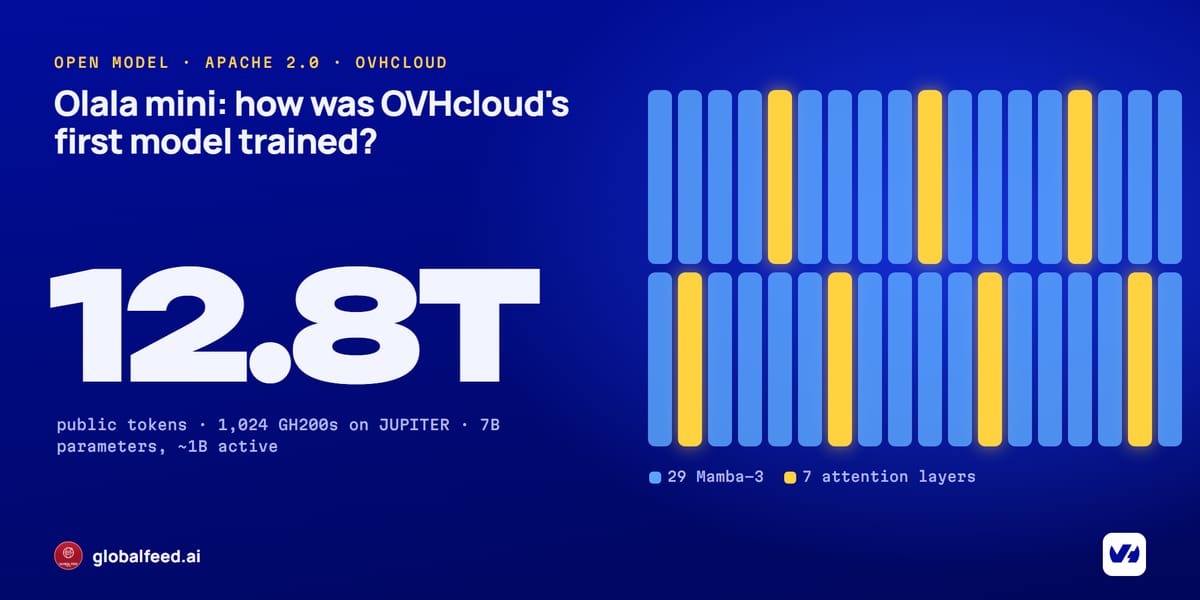
OVHcloud, one of Europe's largest cloud companies, has released its first language model to everyone, files included. Olala v1.0 mini 7A1B, introduced in the company's November 17 announcement, went live on November 19 on the OVHaiLLM page on Hugging Face under the Apache 2.0 licence. The model has about 7 billion parameters but runs only around 1 billion of them per token. According to OVHcloud, it runs on a graphics card with 8 GB of memory and produces 160 tokens per second on an RTX A4500 and 50 tokens per second on an ordinary CPU with no graphics card.
What makes the release stand out is the paperwork that came with it. OVHcloud also published a 70-page technical report and the training content summary required under the EU AI Act. The report covers not just what worked, but what collapsed, which experiments were dropped and which bug broke the quantized builds. Here is how the model was built, how it was trained and how to run it today, based on those documents.
The idea: a lot of knowledge on small hardware
A language model's knowledge lives in its parameters; more parameters mean a model that knows more and costs more to run. The mixture-of-experts (MoE) approach splits the model into many small experts and calls on only a few for each token. Olala mini has 256 experts in every layer, and each token uses 6 of them plus one shared expert that is always on. Think of a library where you open only the few shelves your question needs.
The second idea is about memory. Classic attention layers keep a note for every token in a long text, and this KV cache grows as the text gets longer. Of Olala mini's 36 layers, 29 are Mamba-3 state space layers that carry the text in a fixed-size summary. Attention appears only in every fifth position, 7 layers in total. According to the report, at 32K tokens the design uses 15.7 kB of cache per token, about 4.5 times less than SmolLM3-3B and 8 times less than OLMoE-1B-7B.
Architecture: what went into it
The model card and report detail the design. Layers repeat as four Mamba, one attention (MMMMA). The attention layers combine what OVH calls DiffTPA: differential attention, which subtracts two attention maps to cancel noise, together with Tensor Product Attention, which shrinks the cache. Model width is 1536 and the 151,936-token vocabulary is Qwen-derived. There is no positional encoding; the model learns word order from the Mamba layers and from an attention window that widens gradually during training. Context length is 32K tokens. The report describes a 256K extension, but a footnote says it is not part of this release; according to the announcement, a v1.1 with 128K context is expected around the end of the year.
How it was trained
Data. According to the report, the model was trained only on public data, 12.8 trillion tokens in total. Of the 10.53 trillion tokens in the main pretraining phase, 41.1% is multilingual web text in 36 languages from FineWeb-2, 40.8% is English from Nemotron-CC v2, 8.9% is code, 5.3% is math and 3.9% is translation pairs. Translation pairs were scored with Gemma-3-4B, adult content was removed and every source was checked against the University of Toulouse URL blacklist. The EU summary says data was collected up to January 15, 2026, with no crawling of its own, no user data and no licensed private data.
Data they built. The team wrote about 110 program-verified math generators; problems were translated into 30 languages with Gemma-4-26B-A4B and about 81% passed review. "Active reading" study notes were generated over Wikipedia in 29 languages and over ProofWiki, some checked as Lean 4 proofs against mathlib4.
Pretraining and annealing. Training ran on JUPITER, Europe's supercomputer in Germany, on 1,024 GH200 GPUs with Megatron-LM. Each step processed 256 sequences of 65,536 tokens, about 16.8 million tokens; pretraining took 619,590 steps and the following annealing phase 140,070 steps. The learning rate was found on a small proxy model and transferred to the full one. The attention window grew from 8 tokens to 8K, then to 32K during annealing. In the 2.38-trillion-token annealing mix, math rose to 36.3%; the report's reason is short: their previous model was weak at math.
Fine-tuning. Next came supervised fine-tuning on 210.8 billion tokens of instruction data: 46.4% science, 41.8% general chat, 7.8% code and 2.3% agent tasks. In each category only the top half by the Skywork-Reward-V2 reward model was kept, and the data was run for two epochs on 32 H100s.
A four-stage RL cascade. Finally, a four-stage GRPO reinforcement learning run. Stage one targeted instruction following and math, lifting AIME25 from 25.3 to 42.6. Stage two targeted code, lifting HumanEval+ from 75.3 to 88.1. Stage three covered assistant behaviour and safety, and tool calling recovered from 31.5 to 78.9. Stage four trained agentic search across up to 75 turns.
Compute and energy. The announcement says training used €7 million worth of public compute hours on the JUPITER, MeluXina and Jean Zay supercomputers. The model card puts total energy at about 1.16 GWh and emissions at about 40 tonnes of CO₂ equivalent.
What did not work
This is the most instructive part of the report. The AdEMAMix optimizer, which won at small scale, proved unstable at 7 billion parameters, and the team went back to AdamW. Three Mamba-3 layers (layers 1, 7 and 23) silently collapsed to a single head during training, hidden by the normalization method in use. The report says this, together with activation spikes, explains all their quantization failures, which is why the 4-bit GGUF file was withdrawn. Sparse attention methods NSA, DMA and DSA, Kimi Delta Attention and SwiGLU were also tried and left out. The report adds that four separate reasoning-effort levels made post-training harder and will be dropped in the next version.
Results
The announcement had no comparison scores, but the report and model card include full tables. On OVH's own runs, the base model averages 57.1 across 13 benchmarks, the best among MoE models with about 1 billion active parameters, and ranks second of 12 on MATH with 72.2. The final model averages 68.0 and ranks seventh of 20, scoring 88.3 on HumanEval+, 75.1 on MBPP+, 61.3 on AIME 2025, 83.8 on DROP and 68.7 on the multilingual math test MGSM. It is strongest at instruction following and weakest at competition math. According to the announcement, French search engine Qwant uses the model for its flash answer feature and sees about 20% faster responses at a third of the running cost of the previous model.
How to run it
According to the model card, Olala mini does not yet load in the official llama.cpp, vLLM, Ollama or LM Studio releases; use OVH's vLLM fork or the ovhaillm/olala-vllm Docker image. The --mamba-ssm-cache-dtype float32 flag is required, otherwise the model can fall into repetition loops. It also loads in Transformers with trust_remote_code=True. MLX builds exist for Macs and GGUF builds for PCs; the GGUF card reports 72 tokens per second with q6_k on an M5 MacBook Air. Recommended sampling is temperature 0.8, top_p 0.9 and top_k 40. To try it without installing anything, use OVHcloud AI Endpoints or Hugging Face inference providers. A ready LoRA training image is available for adapting it to your own data; the card says 1,000 examples train in about 7 minutes on a single H200.
The Apache 2.0 licence allows commercial use, modification and redistribution, with the NOTICE file kept in redistributions. For developers who want an open model that runs on modest hardware, it is one of the most thoroughly documented releases of the year.
Sources: OVHcloud announcement, Hugging Face model card, Olala v1.0 mini technical report, EU AI Act training summary

