AWS's Strands Decider v2 decides in one pass: how was it trained?
Five open decision models on Gemma 4 return probabilities without writing text; the 17.5M-row data, the LoRA recipe, the readout layer and what changed from v1.

Most of the decisions an AI agent makes all day are small ones: which model should take this query, is this customer message urgent, which tool should run, does this answer follow the rubric. Asking a large language model to write out each answer is slow and expensive. On November 23, the Strands Agents team at AWS introduced the second generation of open models built for exactly this job: Strands Decider v2, five sizes built on Google's Gemma 4, all under Apache 2.0 on Hugging Face.
We covered the first decider in early October. The second generation grows the training data about 130 times, changes the architecture in two important ways and drops the teacher model entirely.
What a decider does
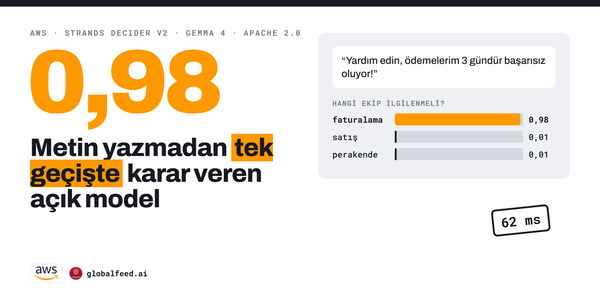
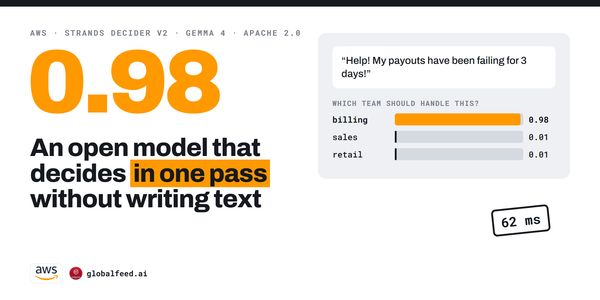
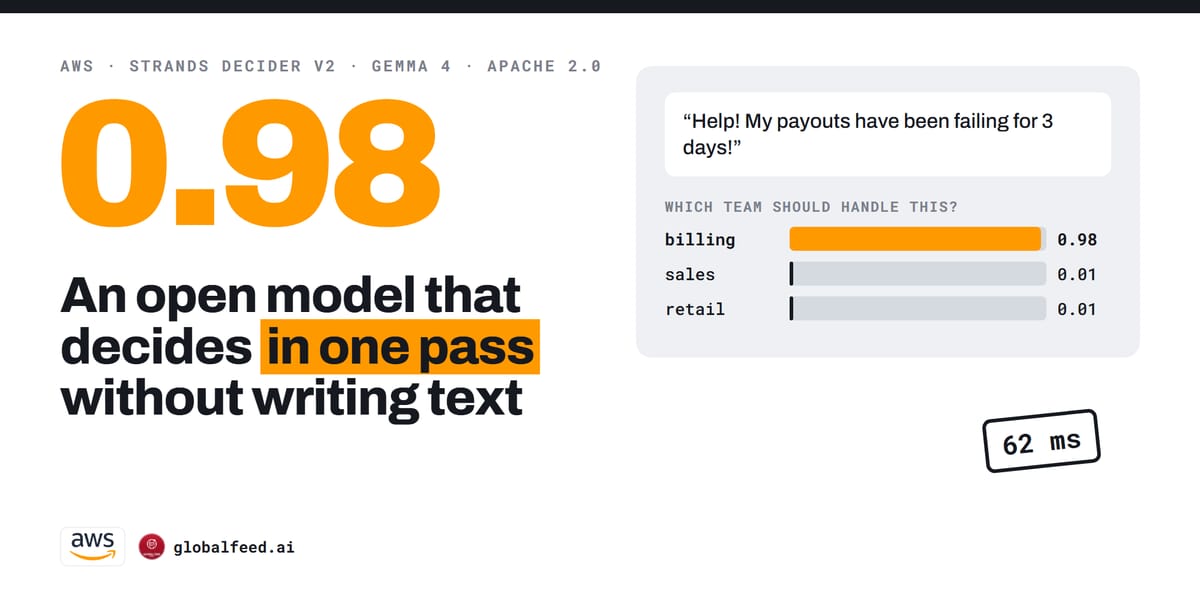
The model writes no text. It takes a "state" (text, JSON or a list) and one or more typed questions: choice (2 to 255 options), yes/no, or a score of 2 to 10 levels. In a single forward pass it returns a probability per option and a confidence value, which the team calls a "system one" model. In the example on the E2B card, the state "Help! My payouts have been failing for 3 days!" gets 0.929 for urgency and 0.98 for the billing team, with confidence 0.97. Intended uses include model routing, tool selection and argument checks, guardrails, rubric evaluation and triage.
Five sizes
E2B has about 2.3 billion effective parameters and runs on a CPU. Then come E4B (4.5 billion effective), 12B, the mixture-of-experts 26B-A4B with 25.2 billion total and 3.8 billion active parameters, and the dense 31B with 30.7 billion. On an H100, a one-question decision takes 62 ms on E2B and 99 ms on 31B.
How it was trained
The v2 data has 17.48 million rows and 8.9 billion tokens, one decision per row. Per the cards, 72% were written by language models from task specifications, which the blog stresses were task descriptions and not benchmark items. Another 6% come from generator programs with computed answers, and 22% from more than 200 public datasets converted to the same format. The data covers 13 topics, is about 96% English and stays under 16,384 tokens per row.
Each size starts from the instruction-tuned Gemma 4 checkpoint with a rank-64 LoRA adapter (alpha 128 per the blog), trained with answer-only cross-entropy for one epoch at roughly 2,700 rows per update. There is no reinforcement learning and no distillation. Three seeds are averaged into a "soup" and merged into the base, and the 26B-A4B also gets rank-8 adapters on each expert with the router frozen. The language-model head is replaced by a 255-row readout initialized from the head's rows for the answer codes A, B, C and so on, and the state is read with bidirectional attention so one encoding serves many questions. A temperature fitted on held-out questions calibrates the probabilities.
Compared with v1, which used 135,602 rows, a pointer head, causal attention, rank-16 adapters and distillation from teachers such as Qwen3.5-4B, v2 simplifies the recipe. The v1 card had flagged weak spots on long multi-step documents and on transferring yes/no and score questions. The team has not published failed experiments or ablations for v2; recipes and configs are in the GitHub repo.
Results
On the self-reported Decision Index 0.3, 31B scores 71.5 against 48.8 for v1's largest model, and E2B jumps from 29.3 to 57.1. On DecisionPivot, 31B scores 84.3 against 23.2. The calibration gap is 0.7 points on 31B and 3.2 on E2B. In the blog's routing test on LLMRouterBench, routing between DeepSeek V3 and Gemini 2.5 Pro reached 88% of Gemini 2.5 Pro's accuracy at 18% of its cost.
How to try it
Install with "pip install strands-decider" (Python 3.11+), then use "strands-decider ask" on the command line, "strands-decider serve" for a local HTTP server bound to 127.0.0.1 without authentication, or "load_decision_engine" in Python. Context defaults to 32,768 tokens and extends to 131,072. The cards advise adding an "out_of_scope" option, since the model always assigns probabilities, tuning confidence thresholds on your own data, and never using it alone for decisions with legal effects such as hiring, credit or health.
Sources: Strands Agents blog, 31B model card, E2B model card, GitHub repository