
Stanford and NVIDIA's CLM is a fast, open model for AI decision-making
Researchers from Stanford University and NVIDIA Research have introduced Contrastive Language Models (CLMs), a new kind of model that lets AI agents pick among options very quickly. CLM-8B is open source and runs on a single GPU.

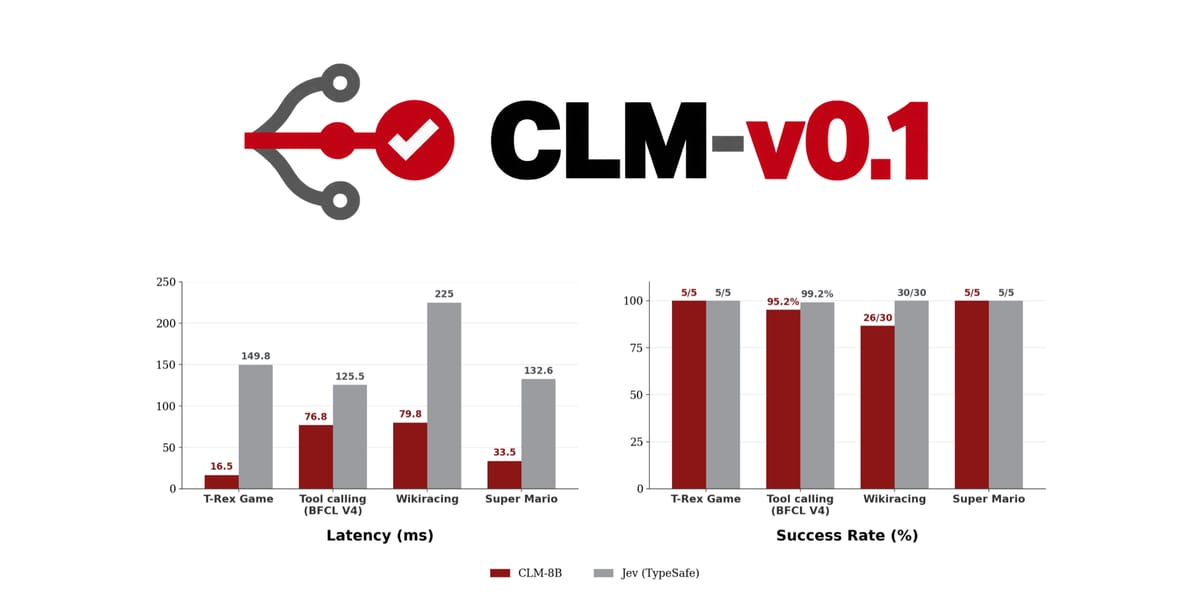
Researchers from Stanford University and NVIDIA Research have introduced Contrastive Language Models (CLMs), a new kind of model. A CLM reads a situation and quickly picks the best option from a given set, rather than writing text like a chat model. The researchers describe it as a "System One" model, after the fast, intuitive kind of human decision. The first release, CLM-8B, is open source with its code, model files and training data.
What CLM is and how it works
A CLM has two parts: one turns the state (say, what is on a screen or a customer's message) into numbers, and the other does the same for possible actions. During training, the model learns to pull each state toward the right action and push it away from wrong ones. In use, given a state and candidate actions, it scores how well each action fits and returns a probability distribution. No extra training is needed for a new task.
Because states and actions are processed separately, actions that come up again and again are served from a cache. According to the researchers, this is what makes the model so fast. CLM-8B consists of two small layers on top of the Qwen3-8B model.
How it was trained
According to the project post, CLM-8B was trained in three stages: first on 60 million question-answer pairs from NVIDIA's Nemotron dataset, then on 30 million synthetic examples with misleading wrong options, and finally on 1 million steps recorded from agents doing real tasks. The researchers also say they show that performance improves predictably as model size, data and compute grow.
Results
According to the researchers, CLM-8B performs on par with Jev, TypeSafe's decision model, on computer-use, gaming and tool-calling tasks, while running up to 9x faster. The gap is largest when there are many options or when the same options are reused often. In the project's charts, CLM trails Jev slightly on some tasks, for example 95.2% versus 99.2% on tool calling. With extra training, CLM was also used as a verifier that picks the best of several coding solutions produced by other models, and it set the top score on two coding benchmarks.
How to use it
CLM installs as the contrastive-lm Python package. Qwen3-8B is served with vLLM, and CLM's roughly 75 MB layer is loaded on top. The project comes with a browser playground. In the sample code, a customer message goes in, and CLM returns in one call whether it is urgent, which team should handle it and how frustrated the customer is, each with probabilities. The project also includes a guide to fine-tuning on your own data.
The work comes from a team led by Jacky Kwok at Stanford, with Hangoo Kang, Tarun Suresh, Jon Saad-Falcon, Marco Pavone, Christopher Ré and Azalia Mirhoseini. The code and model are Apache 2.0 licensed. The training data is mostly English, and performance in other languages has not yet been measured. For a fuller picture, it is worth following evaluations from independent researchers as well.
Sources: CLM project post, GitHub: Contrastive-LM/CLM, Hugging Face: CLM-v0.1-8B.



