OpenAI
OpenAI Starts Rolling Out GPT-6 Astra With 99.9% on ARC-AGI 3
GPT-6 Astra is priced at $10 per million input tokens and $50 per million output, matching Claude Fable 5, and posts top security benchmark scores.
OpenAI
GPT-6 Astra is priced at $10 per million input tokens and $50 per million output, matching Claude Fable 5, and posts top security benchmark scores.
OpenAI
OpenAI has announced Daybreak for Frontline Defenders, a $1 billion commitment to widen access to frontier cyber AI, training and support.
Google Research
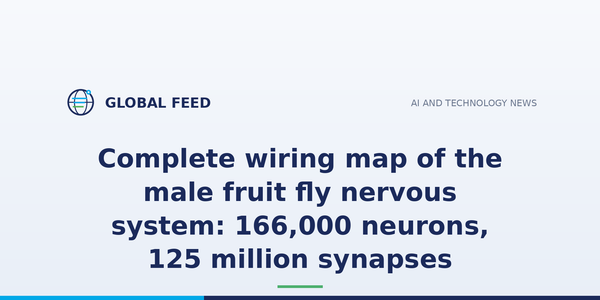
Google Research and HHMI Janelia published the full connectome of the male fruit fly brain and central nervous system in Cell, the largest brain map by neuron count so far.

NVIDIA
Lenovo's Yoga 9n 2-in-1 is the first hands-on look at Nvidia's RTX Spark superchip, which packs a Grace CPU and Blackwell RTX GPU into one SoC.

Google DeepMind
Google DeepMind says WeatherNext 3, built with Google Research, learns directly from real-time observations to produce faster, more localized forecasts.
Perplexity
Perplexity released Lily, the local engine running Qwen3.6-35B-A3B on Apple Silicon, reporting 1.23x faster prefill and 1.35x faster decode than MLX-LM.
cisa
CISA and the G7 Cyber Security Working Group urge organizations to start moving to post-quantum cryptography now, warning that data protected today can be harvested and decrypted later.
openevidence
OpenEvidence released a four-model medical AI family; Darwin scored 100.0% on MedQA in the company's own benchmark table, and none of the numbers has independent verification.
Microsoft
GPT-6 Astra is now in Microsoft Foundry, first through its Limited Access Program, with Foundry pricing published: $10.00 input and $50.00 output per million tokens on Standard Global short context.
context7
Upstash's Context7 has launched Docs7, a documentation platform that, the company says, serves one source as both a human site and agent-readable formats, with analytics on which agents read it.
anthropic
Anthropic says Claude can now click, type and open apps in the background on a user's desktop, in beta on Pro and Max, while its own support page warns there is no sandbox.
Microsoft
Microsoft says attackers used invisible Unicode tag characters, a trick known from AI prompt injection, to split finance-bait words and slip past email filters.