How a 0.8B assistant that runs on your phone, BotPsy, beats a model 2.5 times its size
Tether's AI research team released BotPsy-0.8B, an open model that calls tools for calendar, messaging and device tasks. We cover its benchmarks, four-stage training, weak spots and how to try it.

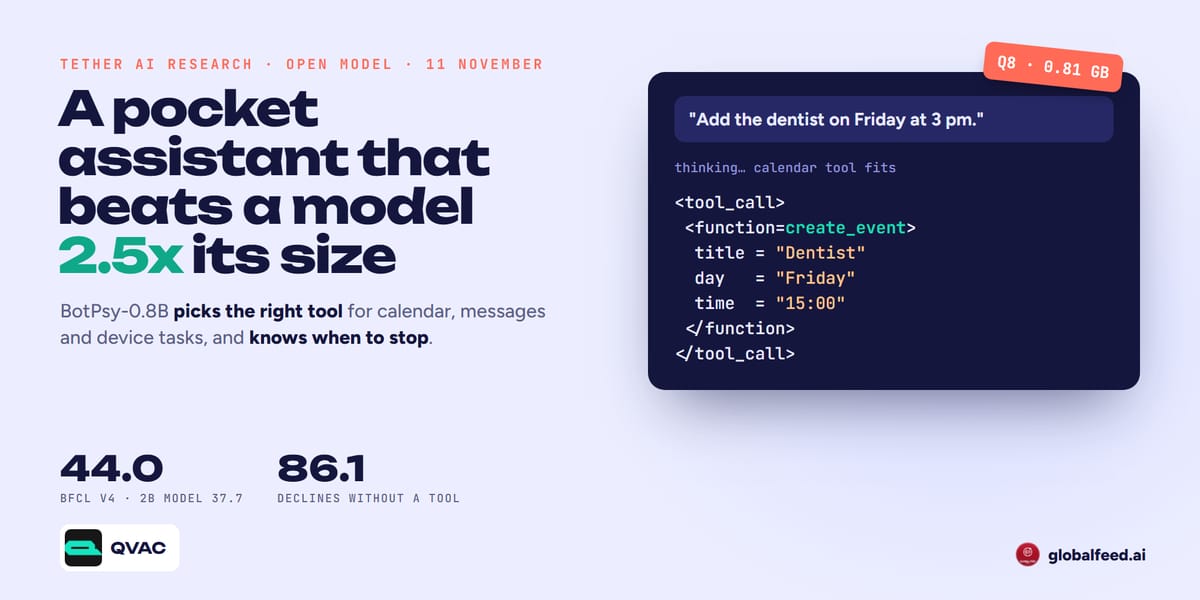
"Add the dentist on Friday at 3 pm." When you say that to an assistant on your phone, a model behind the scenes has to pick the right calendar tool, put the day and time in the right fields and, when needed, say "I don't have a tool for that". On 11 November the AI research arm of Tether released a model trained for exactly this job and small enough to run on a phone: BotPsy-0.8B. It has 0.8 billion parameters, and according to the team's measurements it beats a model 2.5 times its size on most tool-use tests.
BotPsy is a "personal assistant" model built on Alibaba's Qwen3.5-0.8B. It is designed to handle simple tasks by calling tools in areas such as web search, travel, shopping and finance, customer operations, device and vehicle control, files, calendar, email and messaging. The files are on Hugging Face under Apache 2.0, with compressed GGUF versions for phones and laptops. Tether says it developed the model for research and educational use.
Why a small agent
The team opens its write-up with the cost of cloud models. Large models are expensive and their costs fluctuate, providers can change access, and customizing them for specific workflows is limited. Not every task needs the biggest model either: routine jobs like adding a calendar event or finding a file can be done cheaply and quickly by a small, specialized model on the device itself, with the added benefit that the data stays there. BotPsy is a concrete example of that idea: a small, fast model that looks up what it does not know with tools.
What the numbers say
In the team's table, BotPsy roughly doubles the tool-use ability of its base model. BFCL v4, which measures function calling, rises from 23.4 to 44.0, ACEBench from 30.1 to 58.7 and τ-bench, which measures customer-service scenarios, from 23.2 to 51.5. On five of the six tool-use tests it also beats Qwen3.5-2B-Think, a model 2.5 times larger: 44.0 vs 37.7 on BFCL v4 and 64.6 vs 41.2 on ToolSandbox. Only on Claw-Eval does the larger model lead (48.9 vs 46.5). LFM2.5-1.2B-Think and MiniCPM5-1B-Think are also in the comparison; across the six tests BotPsy averages 45.0, ahead of Qwen3.5-2B-Think at 38.8.
The biggest jump is in multi-turn conversations. On the telecom section of τ²-bench, where an agent must hold a long customer conversation and act under a strict policy, BotPsy scores 82.5 against 69.3 for Qwen3.5-2B-Think. On BFCL v4's multi-turn tasks it rises from 7.5 to 46.1. Knowing when not to call a tool matters too: on BFCL's hallucination test, which checks that the model declines when no suitable tool exists, BotPsy scores 86.1, the best of the models tested. In instruction following, IFEval rises from 59.7 to 90.8 and IFBench from 22.0 to 55.9.
It also gets to correct answers with shorter reasoning. On GPQA Diamond questions that all five models answer correctly, BotPsy uses 3,690 reasoning tokens per answer against 11,563 for its base. On IFBench, the rate of getting stuck in repetitive reasoning loops falls from 22.9% to 1.4%, which the team says should cut latency on the device. On safety, automated red-teaming across six harm categories finds unsafe answers 21% of the time, down from 36% for the base and the lowest of the models up to 1.2B parameters.
How it was trained
BotPsy went through four post-training stages, each starting from the best checkpoint of the previous one. In the team's words, the model learned from three kinds of signal: demonstrations, specialist teachers and rule-based rewards.
The first stage is supervised fine-tuning (SFT) on tool-use conversations, updating all parameters. The data includes multi-turn agent trajectories from simulated environments, single, parallel and multi-step calls, and cases where no tool should be called. This stage boosted tool use but had a side effect: general knowledge and instruction following dropped below the base model.
The second stage was designed to win that back: multi-teacher on-policy distillation (MOPD). The team first used reinforcement learning to specialize three Qwen3.5-4B models, one each for tool use, general reasoning and instruction following. The small model then generated its own answers, each prompt was routed to the matching teacher, and the teacher gave feedback on every token, using per-token reverse KL divergence as the training signal. According to the team's chart, this brought knowledge and instruction following back above the base model while tool use kept improving.
The last two stages are reinforcement learning with DAPO, learning only from rewards computed by rules and verifiers. The first round focused on tool calling, with some instruction following and STEM multiple-choice questions. The reward first checks the reasoning and tool-call format, then gives partial credit by matching the predicted tool name, argument names and argument values against the ground truth, in the spirit of ToolRL rather than Tool-N1's binary reward. The second round widened the mix to math, code, knowledge questions, instruction following, structured outputs and multi-step tool use in a simulated workplace. Interestingly, multi-turn function calling still improved even though this mix contained no multi-turn conversations. Training code and data were not released; the datasets used are listed in the model card's licensing section.
Where it shines and where it struggles
The team is open about the limits. On simple scenarios with a single tool call, BotPsy scores 70 to 79 in every app group, 75 overall and about 21 points above its base. On multi-step scenarios the overall score drops to 39.5, against 17.9 for the base and 30.8 for Qwen3.5-2B-Think, with the biggest gains in communication, commerce and device management. Deep research is the weak spot: its 4.5 on BrowseComp-Plus is the best of the five but low in absolute terms. General knowledge still scales with size; BotPsy's 38.1 on GPQA Diamond trails Qwen3.5-2B-Think's 59.9, which is why it is built to look facts up with tools.
BotPsy was mainly trained and tested in English, which is the recommended language. On Multi-IF, which covers eight languages, it does well in Chinese, French, Spanish, Italian and Portuguese but scores much lower in Hindi and Russian. The team stresses that as a small model it makes mistakes and is not intended for high-stakes decisions involving money, health or personal information.
How to try it
Because BotPsy keeps the Qwen3.5 architecture, Hugging Face Transformers, vLLM and llama.cpp run it without custom code. The model card flags two settings: pass enable_thinking=True, since it was trained in thinking mode, and sample with temperature 0.3, top_p 0.95, top_k 20 and presence_penalty 1.5. An OpenAI-compatible server starts with one vLLM command:
vllm serve qvac/BotPsy-0.8B --language-model-only \
    --enable-auto-tool-choice --tool-call-parser qwen3_xml --reasoning-parser qwen3
For phones and laptops, the GGUF repository holds three files: a 1.52 GB BF16, the recommended 0.81 GB Q8_0 and a 0.53 GB Q4_K_M. In the team's tests Q8_0 matches BF16 on average (50.7 vs 50.6), while Q4_K_M is about 1.5 points lower. The files run with llama.cpp and the QVAC SDK, Tether's on-device AI framework. The team says future versions will adapt to user preferences through local fine-tuning and hand heavy tasks from the phone to a home PC.
All scores above are the team's own measurements; still, a file under half a gigabyte handling calendar, messaging and device tasks better than a model 2.5 times its size is an exciting sign for assistants that live on the phone.
Sources: Tether AI Research: BotPsy blog post, Hugging Face: BotPsy-0.8B, Hugging Face: BotPsy-0.8B-GGUFs